James
James
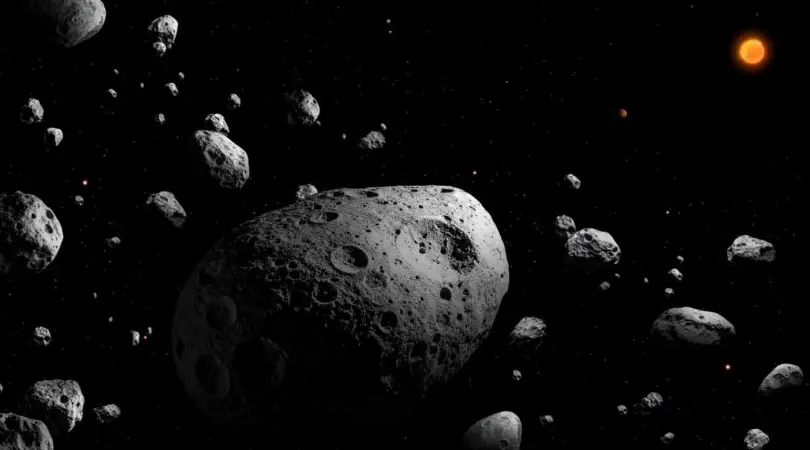
Asteroid defying physics laws has become one of the most talked-about discoveries in space science after astronomers identified a massive space rock that appears to challenge everything we thought we knew about asteroid structure and rotation limits. The object, which should have torn itself apart long ago, is somehow still intact.
Astronomers detected this unusual asteroid in the main asteroid belt located between Mars and Jupiter. Named 2025 MN45, the object completes a full rotation around its own axis in just 1.88 minutes, an incredibly fast speed for an asteroid of its size.
A discovery made before full observations even began
The discovery was made by the Vera C. Rubin Observatory, even before its main observation program officially started. During preliminary observations in April and May 2025, Rubin’s telescope scanned nearly 340,000 asteroids across the solar system.
Out of these, scientists were able to reliably measure the rotation speeds of 76 asteroids. What they found was surprising: 19 of them exceeded the theoretical rotational speed limit that astronomers believed could not be crossed.
Among these, 16 were classified as fast rotators, while three were labeled “extreme fast rotators,” completing a full spin in under five minutes. The most extreme of all was 2025 MN45.
Why this asteroid should not exist
With an estimated diameter of around 710 meters, 2025 MN45 is far larger than asteroids typically capable of spinning this fast. According to long-standing theories, asteroids larger than 150 meters should begin to break apart if they rotate faster than once every 2.2 hours.
Yet this asteroid defying physics laws spins dozens of times faster than that limit—and remains a single, solid object.
Scientists have long believed that most asteroids are “rubble piles,” meaning they are loosely held together by weak gravity, made up of rocks, dust, and debris. When these rubble piles spin too fast, centrifugal forces should cause them to fall apart.
A surprisingly strong internal structure
According to astronomer Sarah Greenstreet, who leads the research team, the only explanation for this behavior is an exceptionally strong internal structure.
“For 2025 MN45 to remain intact at this speed, it must have an internal strength close to that of solid rock,” Greenstreet explains.
This suggests that some asteroids may not be rubble piles at all, but rather dense, solid remnants from the violent early days of the solar system. These objects may have survived countless collisions without breaking apart, preserving ancient planetary material.
A new window into the solar system’s past
What excites scientists most is that this is not a one-off discovery. Even during short test observations, Rubin Observatory identified multiple extreme fast-rotating asteroids. This strongly suggests that the main asteroid belt may contain far more dense and solid objects than previously believed.
These asteroid defying physics laws could offer valuable clues about how the solar system formed and how planets evolved through chaotic and violent processes billions of years ago.
As Rubin Observatory begins its full 10-year survey, researchers expect the number of these unusual objects to increase dramatically, potentially rewriting asteroid science altogether.
The findings have been published in The Astrophysical Journal Letters, marking a major milestone in planetary science.