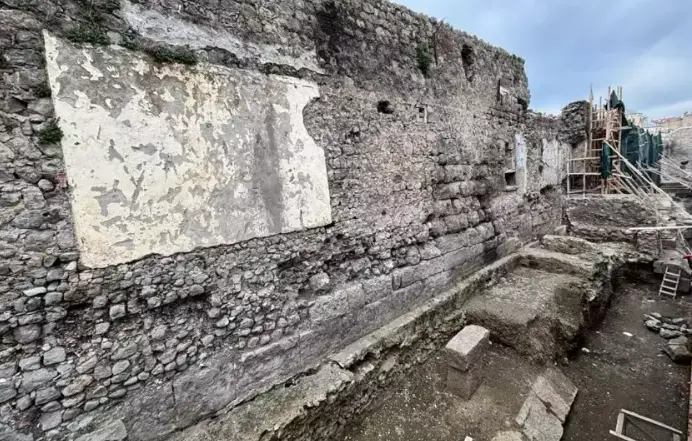

Trabzon underground river port remains have been uncovered nearly 8 meters beneath the surface in the Pazarkapı neighborhood of Ortahisar district, revealing a rare archaeological structure that exists in only three known examples worldwide.
The discovery was made beneath the former Kadınlar Hali Market, which was demolished in 2020. Following revisions to the new construction project, archaeological excavations and restoration work began, leading to the exposure of an ancient river harbor and quay structure connected to the Kuzgundere Stream. Experts have dated the site to between the 1st century BC and the 1st century AD.
A hidden harbor spanning four civilizations
Archaeological studies show that the Trabzon underground river port was used continuously across four major periods: Roman, Byzantine, Ottoman, and Republican eras. This long timeline highlights Trabzon’s strategic importance as a trade center not only during antiquity but throughout history.
During excavations that intensified in 2024, researchers uncovered a massive quay wall measuring approximately 135 meters in length and nearly 2 meters in thickness. The structure extends between 6 and 8 meters below ground level, making it one of the deepest known urban archaeological discoveries in the region.
Rare river harbor structure
According to archaeologist Vedat Keleş and conservation expert Yaşar Selçuk Şener, the structure has been identified as a river port, directly linked to the Kuzgundere Stream. This classification places the Trabzon underground river port among only three known river harbors in the world, making it an exceptionally rare find.
This discovery challenges the long-held belief that ancient Trabzon relied solely on sea-based trade. Instead, it proves that inland waterways and river-connected ports played a crucial role in commercial activity.

Trade evidence from Crimea and Byzantium
Numerous archaeological artifacts were recovered during the excavations. Among the most notable finds was an oil lamp of Crimean origin, discovered near the front section of the harbor. This object provides concrete evidence of trade connections between Trabzon and Crimea during ancient times.
In addition, Byzantine-era pottery fragments and ceramic pieces were found, further confirming that Trabzon’s commercial history extends back well before the Common Era.
Restoration without damaging the original structure
Engineers and conservation teams are using careful restoration techniques to preserve the original fabric of the quay wall. Previous cement-based repairs, which caused damage over time, are being removed. These are replaced with traditional and compatible materials that do not harm the ancient stonework.
After structural reinforcement, joint repairs are completed, and hydraulic lime-based injection materials are applied to fill internal voids. This process strengthens the wall from the inside without altering its historical character.
Protecting the structure for the future
Once the reinforcement process is completed, a protective capping layer is added to the top of the wall. This final step prevents rainwater, dust, and debris from entering the structure, ensuring long-term preservation.
Civil engineer Beyza Nur Yılmaz stated that the excavation area was expanded after localized digs revealed that the walls extended deeper than expected. As excavation continued, additional perpendicular wall structures were discovered, offering new insights into the harbor’s original design and function.
A major contribution to world archaeology
The discovery of the Trabzon underground river port not only reshapes the understanding of the city’s past but also adds a significant chapter to global archaeological knowledge. As excavation and research continue under museum supervision, experts hope to learn more about how this unique river harbor operated and how it supported regional and international trade networks.

0 Comments