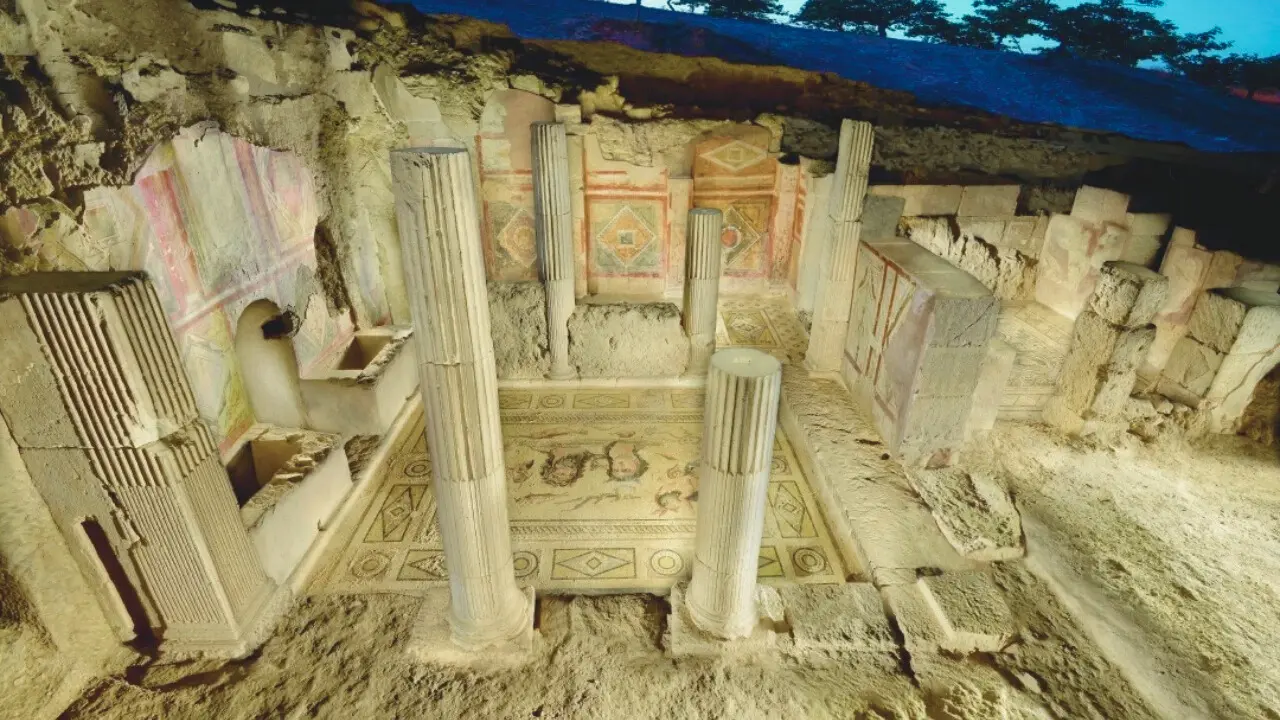
Archaeologists in Türkiye have unveiled one of the best-preserved Roman houses in the ancient city of Zeugma, located near the Euphrates River in Gaziantep’s Nizip district. Known as the House of the Muses, the 2,000-year-old residence has finally been brought to daylight after two decades of excavation, revealing stunning mosaics and frescoes that offer a glimpse into the refined life of a wealthy Roman family.
A Masterpiece Hidden Beneath the Sands of Time
The archaeological excavations began in 2005, under the leadership of Professor Kutalmış Görkay, head of Classical Archaeology at Ankara University’s Faculty of Language, History and Geography.
Supported by Türkiye İş Bankası since 2012, the project has become one of the most significant long-term archaeological efforts in the region.
After 20 years of careful excavation and restoration, the House of the Muses has been fully unearthed, showcasing six exceptionally preserved mosaic panels that once decorated its floors and dining halls.
One of the highlights is the “Muses Mosaic”, depicting nine mythological muses — symbols of inspiration for poets, musicians, and philosophers of antiquity. The mosaic adorned the triclinium, or dining hall, a social hub for intellectual gatherings during the Roman era.
Prof. Görkay: “The House Reflects the Soul of Roman Life in Zeugma”
Speaking about the discovery, Prof. Görkay described the house as “one of the finest examples of Roman domestic architecture in Zeugma, both in structure and in decoration.”
“The design of the House of the Muses likely dates back to the late 1st century AD. Its mosaics and frescoes give us invaluable clues about the social, cultural, and artistic life of the time,” he explained.
Görkay emphasized that the artistic quality of the mosaics — crafted from small pebbles collected from the Euphrates River — demonstrates an extraordinary level of craftsmanship. Roman artisans, he added, used light and shadow effects to create a sense of depth and realism, “much like oil paintings centuries ahead of their time.”
The Role of İş Bank in Preserving Türkiye’s Ancient Heritage
Suat Sözen, Deputy General Manager of Türkiye İş Bankası, stated that their continued support for archaeological excavations reflects the institution’s commitment to preserving the country’s historical and cultural memory.
“Through archaeological work like this, thousands of years of history are brought to light. These discoveries do not just shed light on the past; they illuminate our understanding of the present and guide the future,” Sözen said.
A Collaboration Between City, Academia, and Art Institutions
The excavation site was recently visited by Gaziantep Metropolitan Mayor Fatma Şahin, who expressed pride in the project and praised the engineering brilliance of ancient Roman builders.
“The underground water system from that era shows remarkable engineering skill — something we still admire today,” she said. “If we can promote this heritage properly and bring more visitors here, it can help solve issues like unemployment and even social problems.”
Accompanying Şahin were Prof. Görkay and Zuhal Üreten, General Manager of İş Sanat, who both highlighted how the project merges academic research, public engagement, and cultural tourism.

The Artistry of the Euphrates: Stones Turned into Stories
What makes Zeugma’s mosaics so captivating is not only their beauty but their origin. The tesserae — small stones used in the mosaics — were sourced directly from the Euphrates River, chosen for their color variation and natural polish.
These stones were meticulously arranged to create optical illusions resembling brush-painted artworks. Two millennia later, their vibrancy remains astonishingly intact.
The House of the Muses, with its combination of mythological storytelling, technical mastery, and urban sophistication, embodies the artistic genius of the Roman East.
From Ancient Home to Public Heritage
Now that the excavation is complete, the archaeological team is preparing the site for public visitation. Within a month, the House of the Muses will open its doors to the public, offering visitors a rare chance to walk through a Roman home that once hosted banquets, debates, and artistic performances.
Local tourism authorities expect the site to become one of Gaziantep’s top cultural attractions, alongside the Zeugma Mosaic Museum — already home to world-famous pieces like the Gypsy Girl Mosaic.
Cultural Significance Beyond the Ruins
Zeugma, founded in 300 B.C. by one of Alexander the Great’s generals, Seleucus I Nicator, was once a bustling frontier city between the Greco-Roman world and ancient Mesopotamia. Its strategic location on the Euphrates made it a center of trade, culture, and military defense.
The rediscovery of the House of the Muses adds another layer to Zeugma’s narrative — proving that the city’s role as a bridge of civilizations continues even today through archaeology.
A Timeless Message from the Past
As preparations continue for the public unveiling, Prof. Görkay hopes that visitors will see beyond the artistry and recognize the human stories embedded in each mosaic tile.
“Every mosaic is not just decoration,” he said. “It is a dialogue across time — between the ancient craftsman and today’s observer. Through them, the past speaks directly to us.”
🏺 The House of the Muses: A New Gem in Türkiye’s Archaeological Crown
Once open to visitors, the site will stand as a testament to Türkiye’s ongoing cultural preservation efforts, demonstrating how modern institutions, local authorities, and archaeologists can unite to protect humanity’s shared heritage.
For lovers of history, art, and ancient civilizations, the rebirth of the House of the Muses is not just a discovery — it’s an invitation to step into the living heart of the Roman world.
Leave a Reply