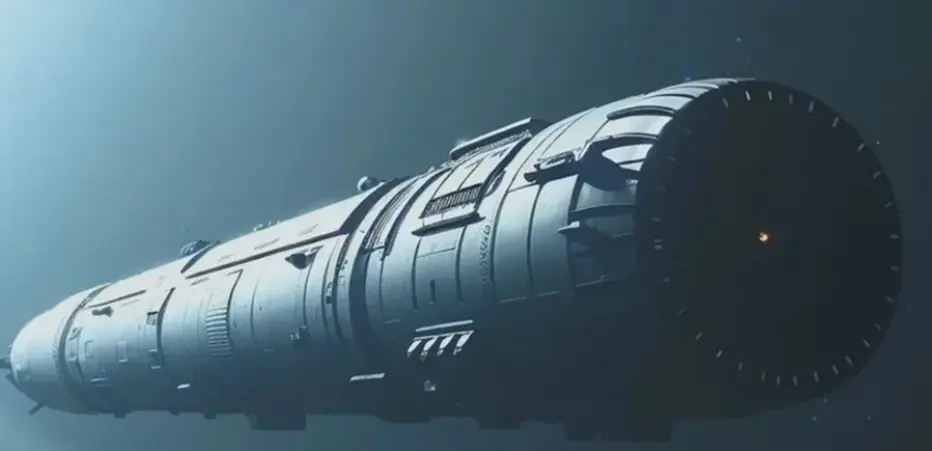
Chrysalis generation ship is the name given to an ambitious and highly detailed theoretical project that aims to take humanity beyond the Solar System on a centuries-long voyage. Designed as a self-sustaining world in deep space, this colossal spacecraft could one day carry thousands of people on a 400-year journey to the nearest star system, Alpha Centauri.
Humanity has dreamed of reaching the stars since ancient times. From early myths to modern science fiction, the idea of settling distant worlds has always captured our imagination. Yet reality remains harsh. Alpha Centauri, often described as our closest potentially habitable neighbor, lies about 4.24 light-years away. With today’s propulsion technology, covering such a distance would take many thousands of years.
A Ship Built for Generations
This is where the Chrysalis generation ship concept comes in. Proposed by Giacomo Infelise and his research team, Chrysalis is not a small, sleek spacecraft like those seen in movies. Instead, it is envisioned as a massive structure stretching an astonishing 58 kilometers in length. To put that into perspective, the ship would be more than twice the length of Manhattan Island.
Unlike fictional starships that rely on faster-than-light travel or frequent resupply stations, Chrysalis would be completely self-reliant. Once it leaves Earth, there would be no turning back. Every resource needed for survival—air, water, food, energy—must be produced and recycled onboard for centuries.
Life Inside a Moving World
The interior of the Chrysalis generation ship is designed to function like a small civilization drifting through space. Plans include not only living quarters, but also schools, hospitals, libraries, and large agricultural zones. Forest-like ecosystems would house insects and animals essential for maintaining ecological balance, while vast farming areas would provide food for the population.
Artificial gravity would be generated through the ship’s rotation, helping future generations avoid the health problems associated with long-term weightlessness. In essence, Chrysalis would be a fully functioning artificial planet, carefully engineered to support human life far from Earth.
Society, Order, and Survival
One of the most challenging aspects of the project is not technical, but social. Keeping thousands of people mentally healthy and socially stable over 400 years inside a closed environment is a daunting task. To address this, the proposal includes strict selection and training processes for the initial crew. Candidates could undergo long-term isolation tests in remote locations such as Antarctica to prepare for life cut off from Earth.
Governance aboard the ship would likely involve assistance from artificial intelligence systems designed to remain neutral and consistent over centuries. Community-based family structures are also emphasized, helping preserve cultural continuity and shared responsibility across generations.
Technology That Does Not Yet Exist
Despite its detailed planning, the Chrysalis generation ship remains purely theoretical. The proposed propulsion system, known as a Direct Fusion Drive, would rely on helium-3 and deuterium fusion. However, no reactor capable of operating reliably at this scale for hundreds of years has yet been built.
There are also serious concerns about long-term structural integrity. Metal fatigue, radiation damage, and unexpected system failures could threaten the mission long before the ship reaches its destination. Even arrival is no guarantee of success. If Proxima Centauri b turns out to be uninhabitable, the mission would face an irreversible and tragic outcome.
A Blueprint for Humanity’s Future?
For now, Chrysalis exists only on paper. We do not know how future generations would cope psychologically with life aboard such a vessel, nor whether the target planet can truly support human life. Still, the Chrysalis generation ship stands as one of the most realistic and thoroughly imagined roadmaps for interstellar migration ever proposed.
It represents not just a spacecraft, but a bold question: if humanity cannot travel fast enough to reach the stars, are we willing to become a civilization that journeys together, generation by generation, through the vast darkness of space?
Leave a Reply