James
James

Alnashetri cerropoliciensis is the name of a remarkable dinosaur that is changing what scientists know about the evolution of some of the smallest predators ever to walk the Earth. This tiny carnivorous dinosaur, which lived around 95 million years ago, was so small that it weighed less than a modern chicken. Its fossil was discovered in the La Buitrera region of northern Patagonia, Argentina, an area famous for its exceptionally well-preserved Cretaceous-era fossils.
The discovery has attracted major scientific attention because it challenges long-held ideas about how a mysterious group of bird-like dinosaurs evolved. Until now, researchers believed that these dinosaurs became small only after adapting to a diet of ants and termites. The Alnashetri fossil suggests a very different story.
A Fossil That Filled a Major Gap
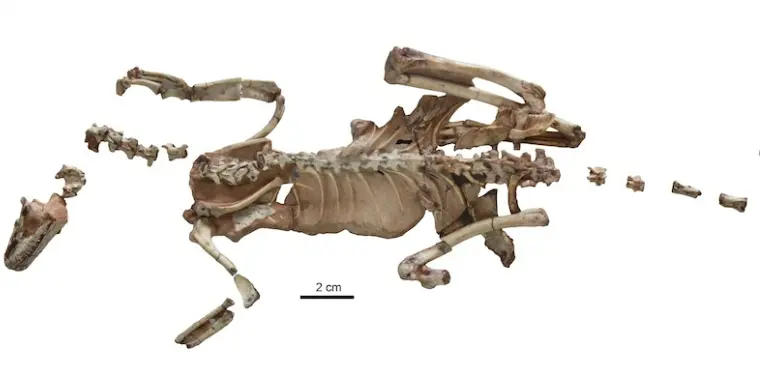
The nearly complete skeleton of Alnashetri cerropoliciensis was studied by researchers Peter Makovicky and Sebastian Apesteguía. Their work, published in Nature, describes what scientists call a crucial “missing link” in the evolutionary history of alvarezsaur dinosaurs.
Alnashetri belongs to the alvarezsaur group, a strange lineage of small, bird-like dinosaurs known for their tiny teeth and short, powerful arms ending in a single enlarged claw. For decades, these animals puzzled paleontologists. Most well-preserved fossils came from Asia, while South American finds were fragmentary and difficult to interpret.
Although Alnashetri was first named years ago based on partial remains, a much more complete fossil was discovered in 2014 in northern Patagonia. This new specimen allowed scientists to carefully reconstruct the animal’s anatomy in detail for the first time. Researchers spent nearly ten years preparing and assembling the fragile bones to avoid damage.
A Dinosaur Preserved by the Desert
The Alnashetri fossil survived in extraordinary condition because it was rapidly buried by a moving sand dune. This natural process sealed the skeleton and protected it for around 90 million years. As a result, scientists now have one of the most complete early alvarezsaur fossils ever found.
According to Makovicky, moving from scattered bone fragments to a nearly complete, articulated skeleton is like discovering a “paleontological Rosetta Stone.” This single specimen now serves as a reference point for identifying other fossils and understanding how body size and anatomy changed over time in this dinosaur lineage.
Small Before Specialized
One of the most surprising findings is that Alnashetri cerropoliciensis still had relatively long arms and larger teeth compared to its later relatives. This shows that some alvarezsaurs became very small before developing the highly specialized features associated with ant-eating behavior.
Microscopic analysis of the bones confirmed that the animal was at least four years old, meaning it was fully grown. These dinosaurs were not juveniles that would later grow larger; they remained tiny throughout their lives. Even the largest members of the group were only about human-sized, which is extremely small by dinosaur standards. Alnashetri itself weighed under one kilogram, making it one of the smallest dinosaurs ever discovered in South America.
A Global History Revealed
By reexamining alvarezsaur fossils stored in museum collections in North America and Europe, the research team also discovered that these dinosaurs appeared much earlier than previously thought. They likely evolved when Earth’s continents were still connected as part of the supercontinent Pangaea.
This means their global distribution was not the result of unlikely ocean crossings, but rather the gradual breakup of Earth’s landmasses. The find helps explain how these small dinosaurs spread across the world.
La Buitrera: A Fossil Treasure
The Alnashetri fossil came from the La Buitrera site, which has also produced fossils of early snakes and small saber-toothed mammals. Scientists say the site offers an unmatched glimpse into the world of small vertebrates in ancient South America.
After more than 20 years of research, La Buitrera continues to reveal new secrets. According to the researchers, additional alvarezsaur fossils from the same area are already being prepared in laboratories, promising even more discoveries in the near future.