James
James

Lighthouse of Alexandria is once again capturing the world’s attention after remarkable underwater discoveries in Egypt’s eastern harbor. Known as one of the Seven Wonders of the Ancient World, this iconic structure had remained silent beneath the Mediterranean for centuries. Now, thanks to modern archaeology and advanced digital technology, parts of its lost story are being brought back to life.
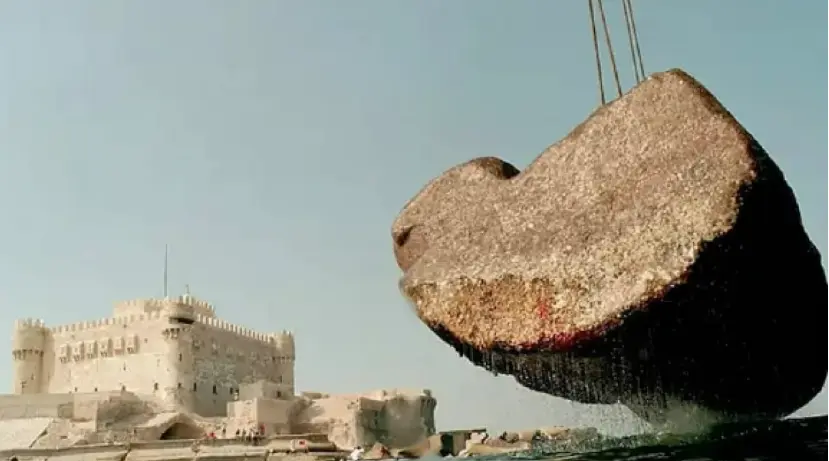
Researchers working in Alexandria have recovered 22 massive stone blocks from the seabed, some weighing between 70 and 80 tons. These pieces are believed to have belonged to the monumental entrance and core structure of the ancient lighthouse. The newly raised remains include lintels, thresholds, and huge paving stones that reveal just how impressive the engineering of the time really was.
More than an excavation
This is not simply a rescue mission for old stones. The international PHAROS project is turning the recovery into something much bigger: a full digital rebirth of the Lighthouse of Alexandria. Led by French archaeologist and architect Isabelle Hairy, and supported by Egypt’s Ministry of Tourism and Antiquities together with the Dassault Systemes Foundation, the project aims to create a highly detailed 3D digital twin of the monument.
That means experts are not trying to rebuild the tower physically. Instead, they are using scanned fragments, historical records, and architectural analysis to recreate the lighthouse in virtual form. Engineers will place every recovered block into a digital model, almost like solving a giant historical puzzle.
A monument that guided sailors for centuries
The Lighthouse of Alexandria was built in the 3rd century BC on Pharos Island, during the reign of Ptolemy I or Ptolemy II. Designed by Sostratus of Cnidus, it stood more than 100 meters tall and served as a guide for ships approaching Alexandria’s busy harbor. For many centuries, it was considered one of the tallest man-made structures in the world and a symbol of the city’s power and brilliance.
Ancient descriptions suggest the tower had three main sections: a square base, an octagonal middle level, and a cylindrical top. A fire at the summit, reflected with polished metal surfaces, may have projected light far out across the sea.
Why it disappeared
The lighthouse survived for well over a thousand years, but a series of powerful earthquakes, especially in the medieval period, caused major destruction. By the 14th century, the structure had largely collapsed. Later, in 1477, Sultan Qaitbay used many of its remaining stones to build a fortress on the same site, further erasing its visible presence from the landscape.
Still, the Lighthouse of Alexandria was never truly forgotten. Its underwater remains have been known since the 20th century, and systematic archaeological work began in the 1990s. Over the years, more than 3,300 objects have been documented in the area, including sphinxes, columns, and obelisks.
A new life in the digital age
What makes this discovery so exciting is not only the scale of the recovered blocks, but also what they can tell us now. With photogrammetry, 3D scanning, and digital modeling, experts can test how the monument was built, how it stood for so long, and why it finally collapsed. The finished digital reconstruction could also allow people around the world to explore the Lighthouse of Alexandria in a way that was impossible before.
This project is giving one of history’s greatest monuments a second life. Even if the original tower never rises again above the coast of Egypt, its image, structure, and story may soon stand clear once more for the modern world to see.