

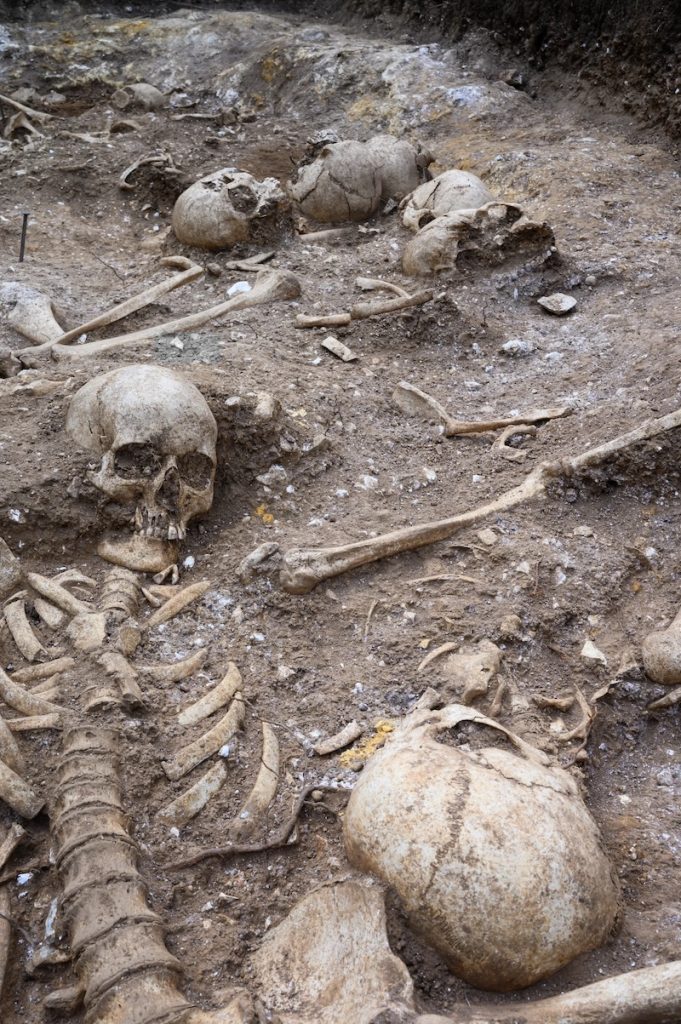
Viking execution pit discovered in England during an archaeological training excavation near Cambridge has revealed a disturbing glimpse into violent events from the 9th century AD. Archaeologists uncovered a mass grave containing the remains of at least ten young male warriors, many of whom appear to have been bound before being thrown into a pit.
The discovery was made as part of an educational excavation organized by the University of Cambridge’s archaeology program. The burial pit, dated to around the 9th century AD, may be linked to a conflict or mass execution during a turbulent period when Saxon and Viking forces fought for control of eastern England.
A mass grave on a historical borderland
The pit was found on the outskirts of Cambridge, in an area that historically lay on the border between the Saxon-controlled Kingdom of Mercia and the Kingdom of East Anglia, which fell under Viking control around AD 870. This borderland saw repeated clashes during the Viking Age, making it a likely location for violence.
Excavated during the spring and summer of last year, the pit contained skeletal remains representing up to eleven individuals based on skull counts. Among the findings were clear signs of trauma, including at least one decapitation.
An unusually tall individual with surgical evidence
One of the most striking discoveries was a nearly complete skeleton of a man aged between 17 and 24. He had been thrown face-down into the pit and is believed to have stood around 196 centimeters tall—exceptionally tall for a time when the average male height was about 167 centimeters.
Even more remarkable was a large oval hole, roughly 3 centimeters wide, found in the left rear portion of his skull. This hole shows signs of healing, indicating that the man underwent trepanation, a surgical procedure in which a hole was drilled into the skull while the individual was still alive.
Trepanation is known from ancient Greek and Roman contexts and is thought to have been used to relieve migraines, seizures, or conditions that today might be considered neurological or psychological disorders.
Possible medical condition behind the height
Dr. Trish Biers, curator of the Duckworth Collections at the University of Cambridge, suggested that the unusually tall man may have suffered from a tumor affecting the pituitary gland. Such a condition could have caused excessive growth hormone production, explaining both his height and potential chronic headaches.
According to Biers, the trepanation may have been an attempt to relieve pressure within the skull, offering rare insight into early medieval medical practices.
Signs of execution rather than battle
The burial pit contained a disturbing mix of intact skeletons and dismembered body parts. Archaeologists found clusters of skulls without matching bodies, piles of legs, and several complete skeletons positioned in ways that suggest their hands or feet were bound.
All individuals appear to have been young men, and the lack of care in burial strongly suggests they were not honored dead. While some injuries are consistent with combat, archaeologists believe there is insufficient evidence to classify the site as a battlefield burial.
Instead, the combination of decapitated heads, stacked body parts, and bound individuals points toward a violent execution, possibly following capture.
A place of punishment and public display
Dr. Oscar Aldred, who led the excavation at Wandlebury Country Park, believes the site may have been used for corporal punishment or public executions. Wandlebury, known since the Iron Age as a significant meeting place, may have retained its symbolic importance into the early medieval period.
Aldred suggests that some body parts may have been displayed as trophies before being buried, possibly alongside newly executed individuals. However, there is little evidence that the bodies were deliberately butchered; decomposition may have already begun before burial.
Historical context of Viking conflict
In the late 8th century, Cambridge was under the control of Mercian king Offa. By the late 9th century, however, half of the Great Viking Army camped near Cambridge and raided the area. The region later became part of the Viking-controlled Danelaw until the early 10th century.
Preliminary radiocarbon dating places some of the remains within this period, but no grave goods were found, making it difficult to determine whether the victims were Saxons or Vikings.
Future research to uncover identities
Further studies will include ancient DNA analysis and isotope testing to determine health, ancestry, and possible familial relationships among the dead. Archaeologists will also attempt to reassemble fragmented remains to establish the exact number of individuals buried in the pit.
These findings may soon clarify whether this grim burial site represents Viking victims, Saxon captives, or a tragic mixture of both.

0 Comments