James
James
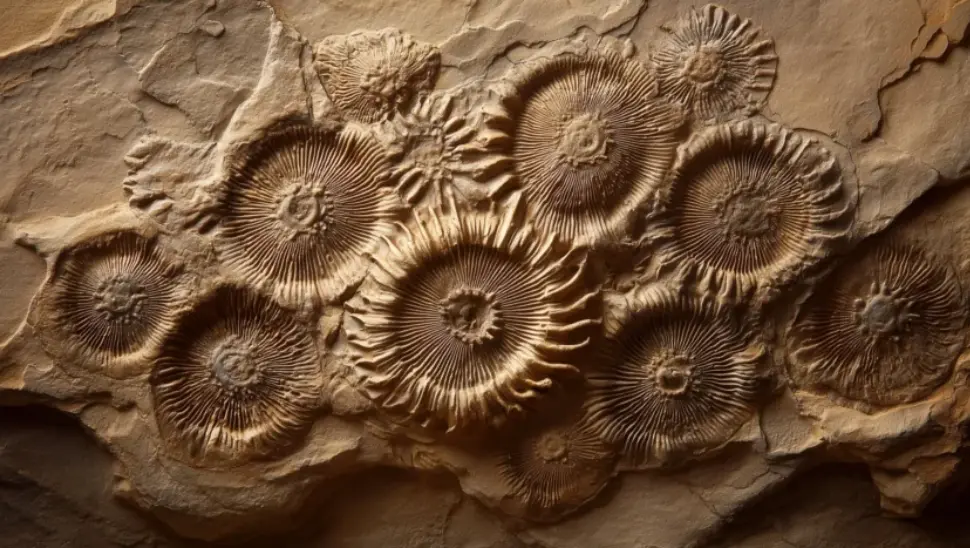
Earth’s strangest fossils have puzzled scientists for decades.
Found in sandstone where delicate life should never survive, these soft-bodied organisms date back nearly 570 million years—long before dinosaurs, fish, or even hard-shelled animals existed. Now, researchers believe they have finally uncovered why these fragile creatures endured when countless others vanished without a trace.
According to a new geological study, the answer does not lie in unusually tough bodies or unknown biological defenses. Instead, it lies beneath ancient oceans themselves. Unusual seawater chemistry during the Ediacaran period transformed ordinary sand into a natural fossil-preserving system, capturing delicate life forms with extraordinary precision.
This discovery reshapes how scientists understand early life on Earth and helps explain a crucial chapter leading up to the Cambrian Explosion—the moment when complex animals rapidly diversified.
Earth’s Strangest Fossils From a World Before Bones
Long before animals developed shells, skeletons, or protective armor, life on Earth looked very different. During the Ediacaran period, roughly 635 to 541 million years ago, the seafloor was populated by strange, soft-bodied organisms unlike anything alive today.
These organisms, collectively known as the Ediacara Biota, include disk-shaped forms, leaf-like bodies, spiral structures, and creatures with fractal patterns or threefold symmetry. Many lack clear mouths, limbs, or organs, making them difficult to classify within modern evolutionary groups.
Normally, such fragile organisms would decay within hours or days after death. In energetic marine environments—especially sandy seabeds shaped by waves and storms—preservation should be nearly impossible.
Yet against all expectations, Earth’s strangest fossils appear etched into sandstone with remarkable clarity.
A Global Fossil Mystery
Fossils of the Ediacara Biota have been discovered on nearly every continent, including Australia, Canada, Russia, Namibia, and the United Kingdom. Their global distribution suggests they were not rare or isolated, but part of a widespread marine ecosystem.
For decades, scientists debated how these fossils formed at all. Some theories proposed that Ediacaran organisms had tougher skin than modern soft-bodied animals. Others suggested rapid burial by microbial mats or unusual sediment conditions.
None of these explanations fully accounted for the level of detail preserved—or for why sandstone, one of the least favorable rocks for fossilization, played such a central role.
New Research Points to Ancient Ocean Chemistry
A recent study led by paleontologist Dr. Lidya Tarhan of Yale University offers a new explanation rooted in geology rather than biology. Published in the journal Geology, the research suggests that Earth’s strangest fossils owe their survival to chemical conditions unique to ancient oceans.
Instead of relying on tough bodies, these organisms were preserved by a process involving authigenic clay minerals—clays that formed directly within the seafloor after burial.
This process effectively “locked in” the shapes of soft tissues before they could collapse or decay.
How Sand Became a Fossil-Making Machine
Sandstone typically forms from loose grains that allow water and oxygen to flow freely, accelerating decay. But during the Ediacaran period, seawater chemistry was very different from today.
Ancient oceans were rich in dissolved silica and iron. When soft-bodied organisms were buried by sand, tiny clay particles already present in the sediment provided surfaces for new minerals to grow.
Over time, chemical reactions caused clay minerals to form directly around the buried bodies. These clays acted like a natural cement, binding sand grains together and stabilizing impressions of delicate tissues.
In simple terms, the seafloor itself became a mold.
Tracing the Process Through Lithium Isotopes
To confirm this theory, researchers analyzed lithium isotopes within Ediacaran fossils collected from Newfoundland and northwestern Canada. These isotopes act as chemical fingerprints, revealing how and where minerals formed.
The results showed that the clays responsible for preservation were not washed in from land. Instead, they formed in place, directly within marine sediments during early burial.
This finding provides strong evidence that Earth’s strangest fossils were preserved because of environmental chemistry—not because the organisms themselves were unusually durable.
Why This Changes Our View of Early Life
This discovery has major implications for how scientists interpret the fossil record. If preservation depended on rare chemical conditions, then many soft-bodied organisms from the same era may have existed but left no trace.
In other words, the Ediacara Biota may represent only a fraction of the life that once inhabited ancient seas.
Understanding this bias helps researchers better evaluate evolutionary timelines and avoids overestimating sudden biological “explosions” based solely on fossil appearances.
A Critical Step Toward the Cambrian Explosion
The Ediacaran period ended just a few million years before the Cambrian Explosion, which began around 540 million years ago. During that time, animals with shells, limbs, eyes, and complex body plans rapidly emerged.
For many years, the Cambrian Explosion was seen as an abrupt evolutionary leap. Today, scientists increasingly view it as the culmination of a much longer process.
The Ediacara Biota represent an important early stage in this transition—a time when organisms were growing larger, more complex, and more ecologically diverse.
By explaining how Earth’s strangest fossils formed, scientists gain a clearer picture of how early animal life developed and why some forms disappeared.
Rethinking Fossilization Across Deep Time
Dr. Tarhan and her team plan to apply the same lithium isotope techniques to other fossil sites and time periods. Their goal is to determine whether similar chemical processes influenced preservation elsewhere in Earth’s history.
If so, this research could transform how paleontologists interpret other exceptionally preserved fossil assemblages, from ancient microbial mats to early animal communities.
It also highlights the importance of environmental context when studying evolution. Fossils are not just records of life—they are records of chemistry, geology, and chance.
Why Earth’s Strangest Fossils Still Matter Today
Beyond their scientific value, the Ediacara fossils remind us how incomplete our understanding of early life remains. Entire ecosystems may have risen and fallen without leaving a trace, erased not by extinction but by unfavorable preservation conditions.
By uncovering the hidden processes that preserved these organisms, scientists are not only solving a geological mystery—they are opening a window into a world that existed long before animals reshaped the planet.
And in doing so, Earth’s strangest fossils continue to reshape how we understand our own origins.