James
James

430,000-year-old wooden tools in Greece have been discovered in the Megalopolis Basin in southern Greece, marking a groundbreaking moment in archaeology. These rare finds are now considered the oldest known hand-held wooden tools ever discovered, offering new insight into the technological abilities of early humans living hundreds of thousands of years ago.
The tools were found near the shore of an ancient lake at the Marathousa 1 excavation site, an area already known for significant prehistoric discoveries. Archaeologists believe the artifacts date back approximately 430,000 years, a period long before modern humans appeared.
Oldest Wooden Tools Ever Found
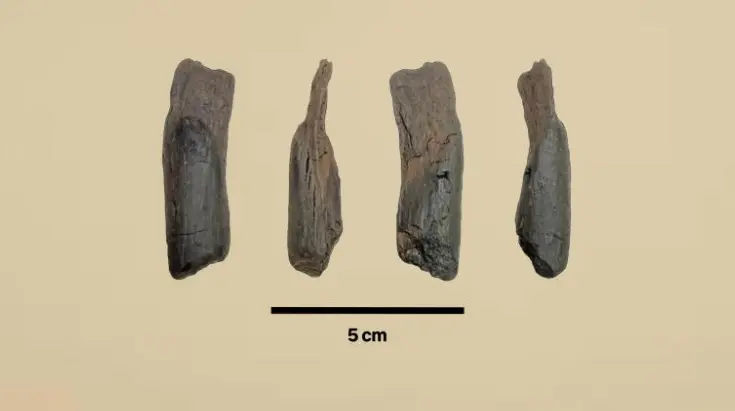
One of the tools is a thin wooden stick about 80 centimeters long, carefully shaped and bearing clear signs of carving. Researchers believe it was likely used to dig into muddy ground or to strip bark from trees. The second artifact is much smaller—about 5.7 centimeters long—and possibly made from willow or poplar wood. Its exact function remains unclear, but experts suggest it may have been used to shape stone tools.
Microscopic analysis revealed cutting and scraping marks, strong evidence that these objects were deliberately crafted by early human ancestors, known as hominins.
Why Wooden Tools Are So Rare
Scientists have long suspected that early humans used wood, bone, and other organic materials alongside stone tools. However, wood rarely survives for hundreds of thousands of years unless preserved under very specific conditions such as waterlogged environments, ice, or caves.
In the Megalopolis Basin, the wooden tools were quickly buried under sediment and remained in a constantly wet environment, allowing them to survive far longer than usual. The same area previously yielded stone tools and elephant bones with cut marks, indicating active human presence.
Who Made These Tools?
Although the tools themselves were not directly dated, the age of the surrounding sediment provides a reliable estimate. No human remains have been found at the site yet, so researchers cannot say for certain who made them. Possible candidates include Neanderthals or even earlier human species.
According to experts, these discoveries suggest that early humans had a far more diverse toolkit than previously believed.
A Major Contribution to Archaeology
Similar wooden artifacts have been found before, such as wooden spears in Germany, digging sticks in China, and a 476,000-year-old wooden structure in Zambia believed to be part of a flood-resistant construction. However, all of these are younger than the Greek discoveries.
The findings were published in the peer-reviewed journal PNAS on January 26, 2026. Annemieke Milks, one of the study’s authors from the University of Reading, explained that close microscopic examination confirmed the tools were intentionally shaped.
Katerina Harvati from the University of Tübingen described the discovery as shedding light on a little-known aspect of early human technology, highlighting how crucial wooden tools were for survival.
A New Perspective on Early Human Life
These 430,000-year-old wooden tools in Greece challenge long-held assumptions about prehistoric technology. They prove that early humans were not limited to stone tools alone but were capable of crafting complex wooden implements to adapt to their environment.
As excavations continue, researchers hope to uncover even more evidence that will further transform our understanding of early human innovation.