James
James
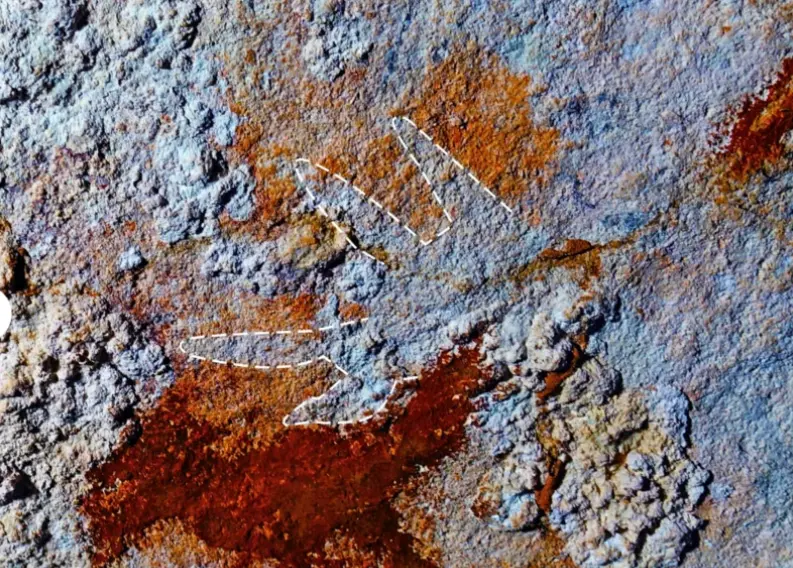
The World’s Oldest Rock Painting has been discovered in a remote cave in Indonesia, marking a groundbreaking moment in human history and art. This extraordinary finding pushes the origins of symbolic expression further back than scientists ever imagined and challenges long-held beliefs about where human creativity truly began.
A 67,800-Year-Old Hand Stencil in Indonesia
The World’s Oldest Rock Painting was found inside Liang Metanduno Cave, located along the Sulawesi coast of Indonesia. Researchers confirmed that the hand stencil is at least 67,800 years old, making it the oldest known example of cave art ever discovered.
The image is a red hand stencil created by placing a hand against the cave wall and blowing pigment around it. What makes this artwork unique is the deliberate shaping of the fingers into a claw-like form, suggesting imagination and symbolic thinking rather than simple decoration.
According to research published in Nature, this ancient artwork is likely linked to the ancestors of Aboriginal Australians, offering new clues about early human migration and culture.
A Cultural Tradition Hidden in Plain Sight
Professor Maxime Aubert from Griffith University in Australia explained that the discovery was not entirely unexpected. He believes these artworks represent a deeply rooted cultural tradition that remained unnoticed for decades due to technological limits.
Previously, scientists could not precisely date cave paintings. Today, advanced uranium-thorium dating allows researchers to measure the age of calcite layers that form over paint, providing reliable minimum ages for ancient artworks.
By analyzing how uranium decays into thorium, scientists determined the mineral layer covering the painting dates back 67,800 years—meaning the artwork itself could be even older.
What This Discovery Reveals About Human Migration
The World’s Oldest Rock Painting also offers vital insights into ancient migration routes. Scientists have long debated how early humans traveled from the Sunda landmass—covering Borneo, Sumatra, and Java—to Sahul, which included Australia, New Guinea, and Tasmania.
This discovery strongly suggests that some human groups traveled through Sulawesi, supporting the theory that modern humans reached northern Australia at least 65,000 years ago—much earlier than once believed.
Redefining the Origins of Creativity
For decades, many researchers believed that symbolic thinking and creativity emerged suddenly in Ice Age Europe around 40,000 years ago. However, discoveries across Sulawesi over the past decade have completely reshaped that narrative.
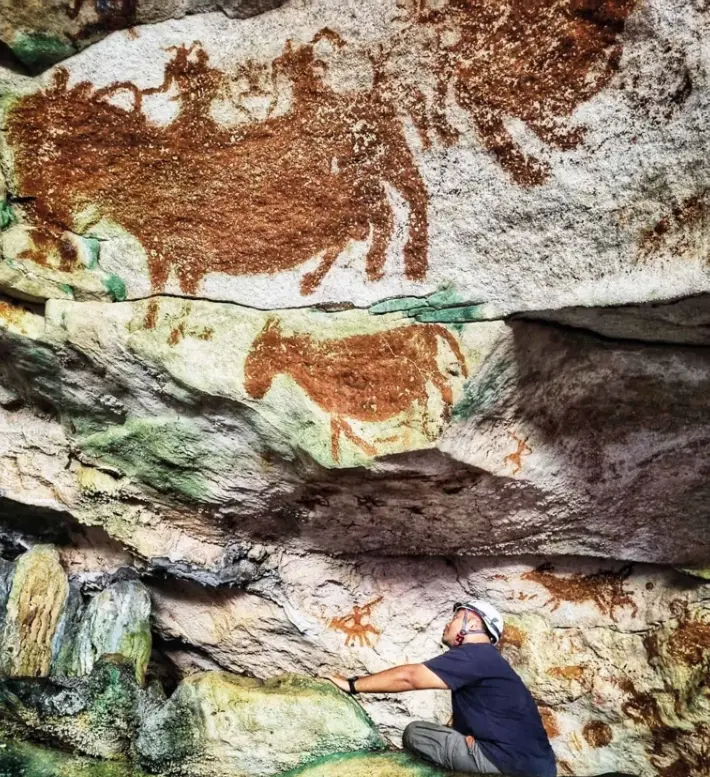
Earlier finds include hunting scenes, animal figures, and narrative artwork dating back over 51,000 years. Together, they prove that abstract thought and storytelling existed far beyond Europe and much earlier in time.
Professor Adam Brumm, one of the study’s directors, emphasizes that these findings make it increasingly difficult to support Europe-centered theories of human creativity.
Why This Hand Painting Matters
Cave art is widely considered a sign of abstract thinking—the foundation of language, religion, science, and storytelling. The deliberate transformation of a simple hand stencil into a symbolic claw demonstrates conscious artistic intent.
Researchers stress that this is a deeply human act. Unlike other species, early humans didn’t just react to the world—they represented it, shared ideas, and told stories through images.
A New Chapter in Human History
The discovery on nearby Muna Island further supports the idea that artistic expression was widespread across the region. Similar styles found in different locations suggest that cave art was a shared and deeply embedded cultural practice.
Scientists now believe that humans possessed creative and symbolic abilities long before leaving Africa, and carried these traits with them as they migrated across the world.
As Professor Aubert explains, this discovery shows that human imagination has existed for far longer than previously assumed—possibly from the very beginning of our species.