James
James
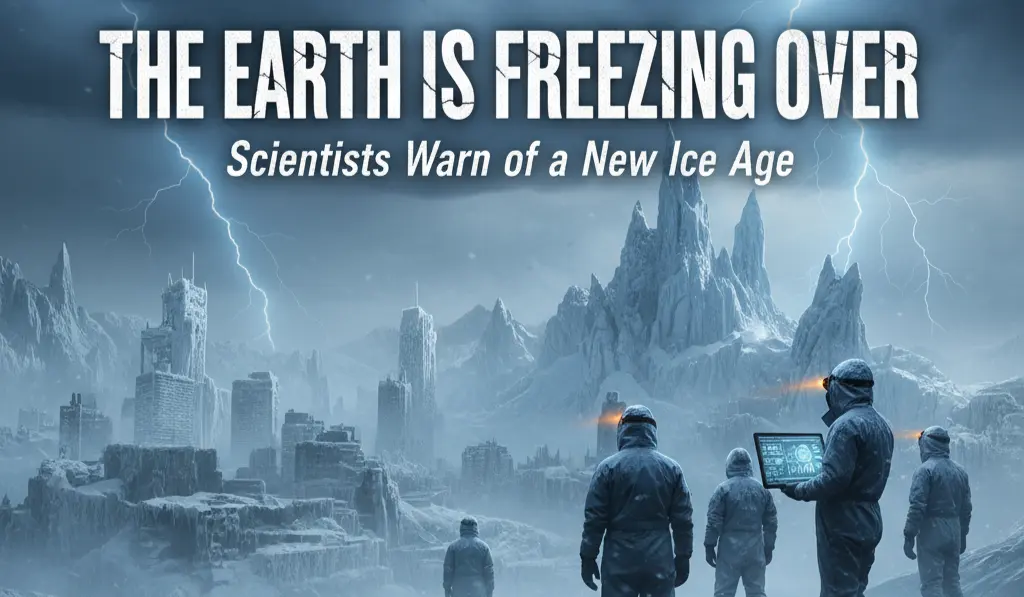
As humanity continues to grapple with global warming, scientists have unveiled a startling possibility: Earth may soon plunge into a new ice age — not because of human inaction, but due to the planet’s natural balancing mechanisms overreacting to rising temperatures.
A recent study by climate researchers Dominik Hülse and Andy Ridgwell suggests that the Earth’s self-regulating climate systems might, under certain conditions, trigger a massive cooling period that could last for tens of thousands of years.
The Ancient Mechanism That Keeps Earth in Balance
For millions of years, Earth has maintained its climate through a process known as the silicate weathering cycle. When rain falls, it absorbs carbon dioxide (CO₂) from the atmosphere. As the rainwater flows over exposed rock, it slowly dissolves minerals in a process that traps CO₂ and carries it into the oceans.
Once there, marine organisms like corals and shellfish use these minerals to build their calcium carbonate skeletons. When these creatures die, their remains sink to the seafloor, locking carbon deep within Earth’s crust for millions of years.
According to Hülse:
“When the planet warms, rocks weather faster and absorb more CO₂, which cools the planet down again. It’s nature’s thermostat.”
Why Earth Sometimes Overreacts
Throughout Earth’s history, however, this “climate thermostat” hasn’t always worked smoothly. There have been periods when the planet froze entirely, covered in snow and ice from pole to equator — known as “Snowball Earth” events.
Researchers say that the silicate weathering process alone cannot explain such extreme freezes. Instead, other feedback mechanisms — particularly involving ocean nutrients and carbon burial — likely played a key role.
When atmospheric CO₂ rises, global temperatures climb. Warmer climates increase rainfall and nutrient flow — especially phosphorus — into the oceans. This stimulates the growth of algae, which absorb carbon through photosynthesis. When algae die, they sink to the ocean floor, taking trapped carbon with them.
But in a warmer world, there’s a catch.
As algal blooms grow larger, they consume more oxygen. This reduces oxygen levels in the ocean, leading to the recycling of phosphorus instead of its long-term burial. The result? A dangerous feedback loop:
- More nutrients in the water
- More algal growth
- Less oxygen
- More nutrient recycling
- Even greater carbon burial — and eventually, global cooling
Computer Models Reveal a Surprising Climate Reaction
For years, Hülse and Ridgwell have been working on advanced Earth system models that simulate these interactions between the ocean, atmosphere, and land.
Their simulations show that after periods of warming, Earth’s climate doesn’t always stabilize slowly. Sometimes, it overcorrects, sending the planet’s temperature far below its starting point — into a deep freeze.
As Hülse explains:
“Our more complete model shows that the Earth’s climate system doesn’t just gently rebalance itself after warming. Sometimes, it reacts too strongly, cooling the planet to levels far below its initial temperature. That can trigger a new ice age lasting hundreds of thousands of years.”
This phenomenon could help explain the extreme ice ages of the past, which simple rock-weathering theories could never fully account for.
The Role of Oxygen and the Deep Past
The team also found that in periods when Earth’s atmosphere contained less oxygen, these nutrient feedback loops were stronger — potentially setting the stage for runaway cooling events.
Their findings suggest that such overreactions have occurred before, shaping the planet’s climate evolution and possibly influencing the development of early life forms.
Could It Happen Again?
Today, humans are driving rapid increases in CO₂ levels, pushing global temperatures higher than at any point in modern history.
So, could this same self-correcting mechanism eventually swing Earth the other way — toward another ice age?
The researchers say it’s theoretically possible, but not soon.
“Whether the next ice age starts in 50,000, 100,000, or 200,000 years doesn’t matter much right now,” says Ridgwell.
“Our focus must remain on reducing current warming. Even if Earth will one day cool naturally, it won’t happen fast enough to save us from the impacts we’re facing now.”
A Reminder of Earth’s Fragile Balance
The new research underscores how delicate and interconnected Earth’s climate system truly is.
From the slow dissolution of rocks to the unseen chemistry of the deep ocean, every natural process plays a role in keeping the planet habitable.
While a future ice age may sound distant, the findings are a powerful reminder: climate change is not linear. Small changes today can set off massive, long-term planetary shifts that last for millennia.