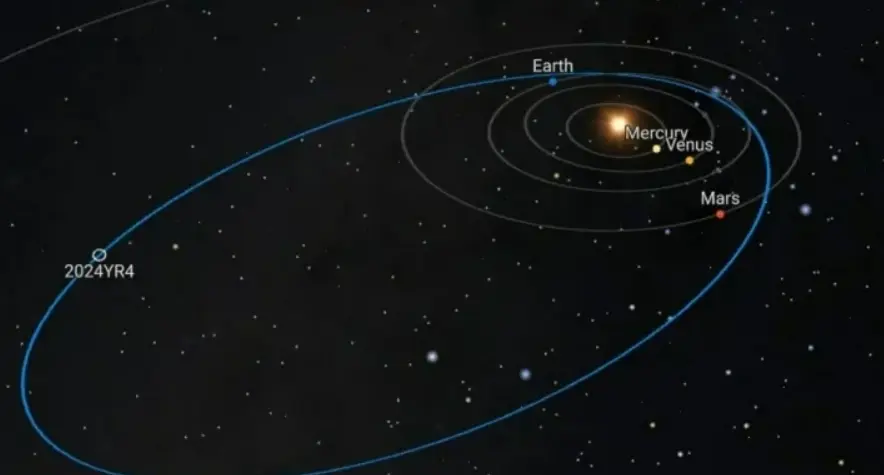
60 meter asteroid hitting the Moon is no longer just a distant space theory. According to the latest scientific calculations, there is a 4 percent chance that a massive asteroid could collide with the Moon in 2032, prompting scientists to actively prepare for both dangerous and scientifically valuable outcomes.
Although a 4 percent probability may sound small to the general public, experts say this number is too high to ignore. Space researchers and global space agencies are now closely monitoring the asteroid and running simulations to understand what could happen if the collision becomes a reality.
What do scientists know about the asteroid?
According to a report published by ScienceAlert, the asteroid — named 2024 YR4 — measures approximately 60 meters wide. If it crashes into the Moon, it would create a new crater nearly 1 kilometer in diameter. The impact would be powerful enough to be visible to the naked eye from the Pacific region on Earth, turning the event into a rare cosmic spectacle.
Scientists emphasize that such an impact is not just about destruction. It also presents a unique scientific opportunity to observe the Moon in ways that have never been possible before.
A natural laboratory on the Moon
If the asteroid hits the Moon, the resulting seismic waves would travel deep into the lunar interior. This would allow researchers to study the Moon’s internal structure, geology, and chemical composition in unprecedented detail.
Advanced observation tools such as the James Webb Space Telescope could monitor the cooling process after the impact, helping scientists understand how craters form and how heat behaves on the Moon’s surface after a major collision.
Potential risks for Earth and satellites
Despite the scientific excitement, experts warn of serious risks. After the impact, dust and rock fragments could be ejected from the Moon and move toward Earth’s orbit.
An estimated 400 kilograms of debris could threaten satellites responsible for navigation, communication, and internet services. Scientists fear this could trigger the Kessler Syndrome, a chain reaction where space debris collides with satellites, making Earth’s orbit increasingly dangerous for future space missions.
Meteor showers and visual spectacle
On a more positive note, if the debris enters Earth’s atmosphere, it could create an extraordinary meteor shower, with up to 20 million meteors per hour, offering a breathtaking visual event for observers around the world.
Will scientists try to stop it?
Space agencies are already discussing a possible asteroid deflection mission if the risk increases. During the asteroid’s close pass in 2028, precise measurements will determine whether intervention is necessary.
In the end, scientists may face a difficult choice:
protect Earth’s orbit or observe one of the most valuable lunar impact events in history.
Leave a Reply