
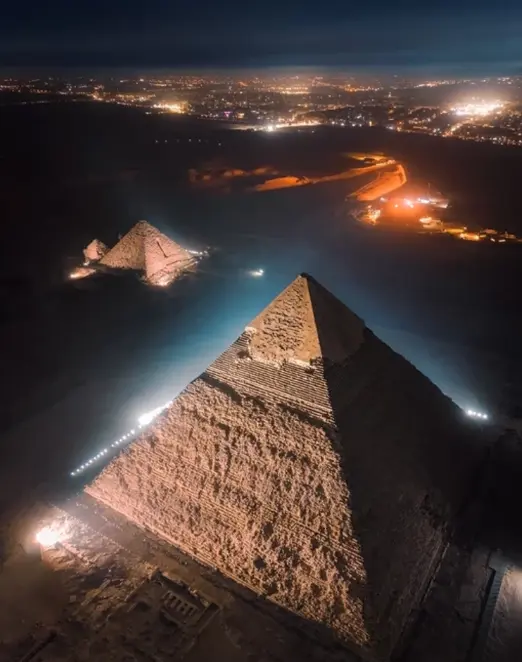
What Is Hidden Beneath the Giza Pyramids? This question is once again shaking the world of archaeology and ancient history. New radar-based findings shared by Italian scientist Filippo Biondi suggest that the famous pyramids of Egypt may be only a small visible part of a much larger and far older underground system. If these claims are accurate, much of what we think we know about ancient civilizations could need serious revision.
The Giza Pyramids, long believed to be royal tombs built over 4,500 years ago, are among the most studied structures on Earth. Yet despite centuries of research, their true purpose continues to fuel debate. Recent discussions, reignited by popular podcaster Joe Rogan, have brought Biondi’s controversial research into the global spotlight.
Are the Pyramids More Than Tombs?
During a recent podcast episode, Rogan discussed radar scans conducted by Biondi and his team beneath the Giza Plateau. According to the data, the pyramids may not be standalone monuments at all. Instead, they could sit atop a massive underground complex.
Rogan summarized the claims bluntly: “These aren’t just tombs. If the data is correct, the pyramids are only the tip of the iceberg.” That statement alone has been enough to divide experts and ignite online debate.
Inside the Radar Scans and Technology Used
At the center of these claims is the Khafre Project, led by Filippo Biondi. The team used Synthetic Aperture Radar (SAR) technology, which allows scientists to analyze underground structures by interpreting reflected radio waves from satellite imagery.
According to Biondi, data was gathered using multiple satellite systems, including Italy’s COSMO-SkyMed and the U.S.-based Capella Space network. Over 200 radar scans reportedly revealed spiral-shaped vertical structures roughly two meters wide, descending deep beneath the pyramids and leading into massive underground chambers measuring up to 80 meters in length.
Even more striking are claims of horizontal corridors intersecting these shafts at depths reaching over 600 meters, something previously thought impossible using conventional archaeological tools.
Links to Zep Tepi: Egypt’s Mythical First Age
Biondi argues that these underground structures may date back 18,000 to 20,000 years, far earlier than the accepted timeline of ancient Egypt. He links them to Zep Tepi, a legendary era in Egyptian mythology described as “the First Time,” when the gods ruled Earth and civilization began.
Adding to the mystery, salt deposits discovered beneath the plateau suggest ancient flooding, possibly pointing to a lost civilization that existed long before dynastic Egypt.
Scientific Pushback and Fierce Criticism
Not everyone is convinced. Renowned Egyptian archaeologist Dr. Zahi Hawass dismissed the findings outright, calling them “nonsense.” He argues that radar technology cannot reliably penetrate more than 20 meters underground, making claims of deep underground cities scientifically impossible.
Biondi strongly disagrees. He insists the technology does not “penetrate” the Earth but instead measures surface entropy patterns that reveal hidden structures. He also claims the findings were cross-verified using different satellite systems.
Calls for Robotic Exploration Instead of Excavation
Rather than traditional excavation, Biondi proposes using robotic drones to explore the underground system. This approach, he argues, would protect the site while providing definitive answers. The estimated cost of such an operation is around $20 million, a figure that has sparked further debate among Egyptian authorities.
Ancient Alien Theories Resurface
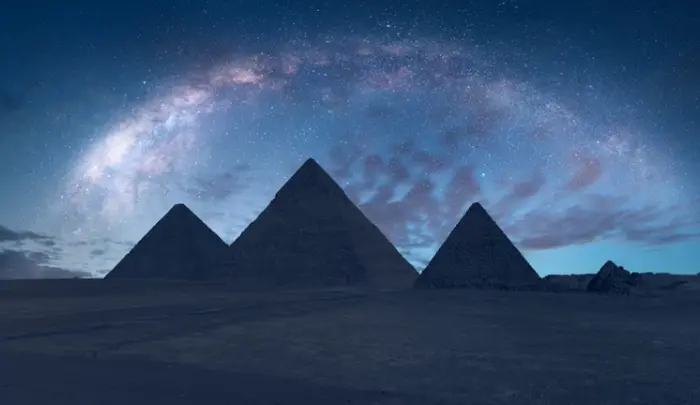
As expected, these revelations have reignited ancient alien theories. Author Erich von Däniken, famous for Chariots of the Gods, argued decades ago that the pyramids’ engineering complexity could not be explained by human capability alone.
He pointed to the Great Pyramid’s precise alignment with Earth’s meridian, its mathematical relationship to Pi, and its staggering mass as evidence of advanced external knowledge. Even modern figures like Elon Musk have jokingly referenced the idea, once tweeting, “Aliens built the pyramids, obviously.”
A Mystery Far From Solved
Whether these radar findings represent groundbreaking discovery or misunderstood data remains unclear. What is certain, however, is that the question What Is Hidden Beneath the Giza Pyramids continues to challenge established narratives and captivate the world.
As technology advances and pressure mounts for deeper investigation, the sands of Giza may yet reveal secrets buried far longer than anyone imagined.

0 Comments