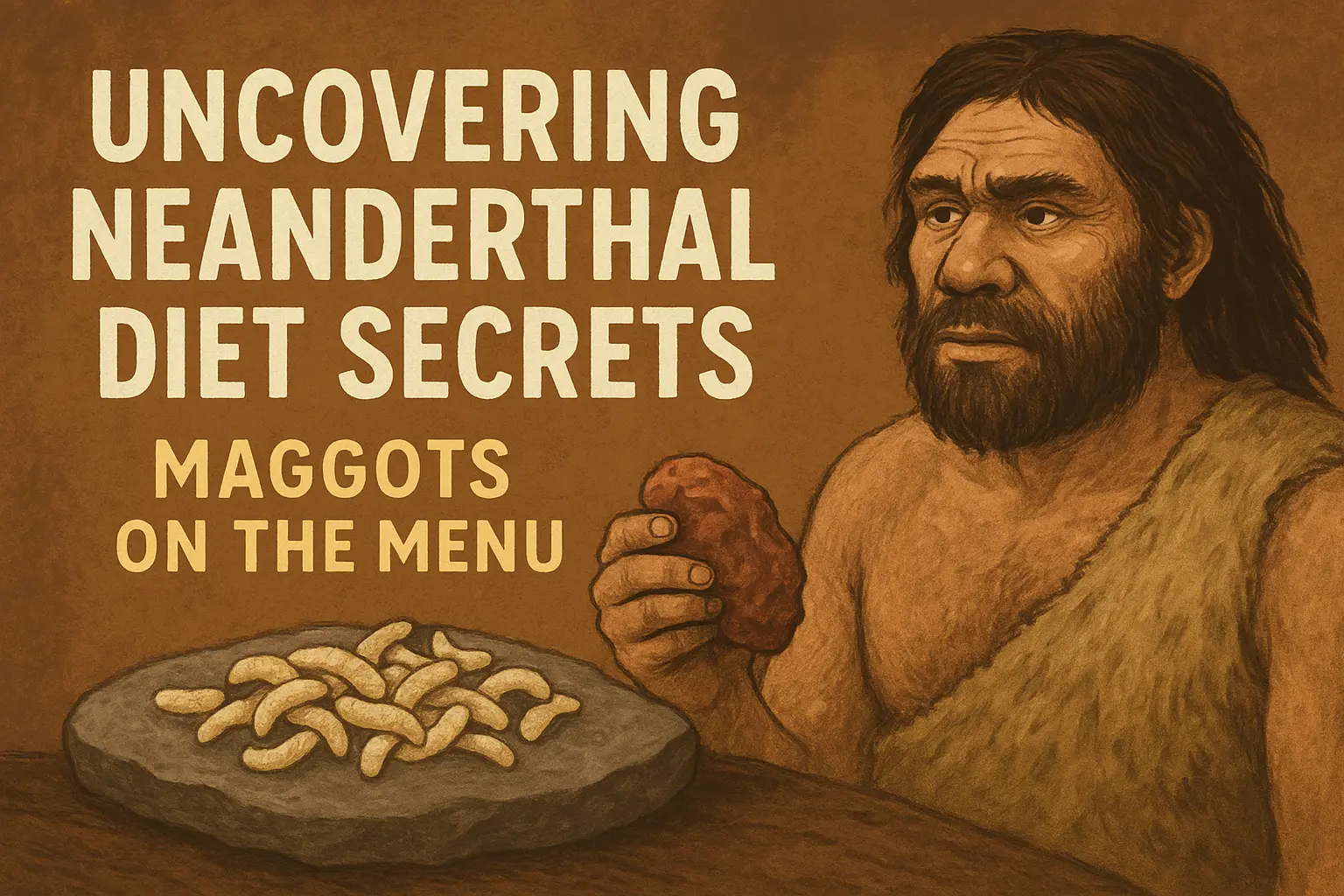
For decades, the prevailing image of Neanderthals depicted them as hyper-carnivorous apex predators, consuming massive quantities of meat while competing with cave lions and saber-toothed cats. However, recent studies challenge this long-held notion, revealing a more complex, opportunistic diet in which maggots and decaying meat played a surprisingly important role.
Rethinking the Neanderthal Menu
Traditional archaeological interpretations were influenced by the high nitrogen isotope levels found in Neanderthal bones, which were taken as proof that these prehistoric humans were among the top meat-eaters of their era. But as Professor John Speth from the University of Michigan explains, “Neanderthals were not hyper-carnivores. Their dietary habits were far more diverse, and maggots likely represented a key nutritional resource.”
The Protein Puzzle
One of the critical questions for anthropologists has been how Neanderthals achieved such high nitrogen levels in their bones. Humans, Speth notes, can only safely metabolize up to 4 grams of protein per kilogram of body weight per day, unlike large carnivores such as lions, which can tolerate much higher levels. This means that Neanderthals could not have relied solely on fresh meat to reach the protein levels indicated by isotopic analyses.
This opens the door to alternative protein sources. Decaying meat and the maggots that feed on it may have been a crucial supplement to their diet, providing the nutrients needed without overwhelming their metabolic systems.
Maggots: A Surprising Nutritional Source
Research from Purdue University by Dr. Melanie Beasley highlights that decayed meat contains significantly elevated nitrogen levels, particularly concentrated within the maggots that feed on it. By consuming these larvae, Neanderthals could have accessed dense protein and fat sources that helped them maintain high-energy lifestyles without overconsuming raw meat.
As the study published in Science Advances points out, Neanderthals were not just opportunistic hunters—they were strategic foragers. By allowing meat to decay and harvesting the nutrient-rich larvae, they effectively expanded their protein repertoire and mitigated the risks of relying exclusively on fresh kills.
Global Perspectives on Insect Consumption
Professor Karen Hardy of Glasgow University emphasizes that the idea of maggots as food may seem unusual from a Western cultural perspective, but it is far from unprecedented. “In many regions across the world, insects are regular dietary staples. They are high in protein, fat, and essential amino acids, making them a highly efficient source of nutrition.”
For Neanderthals, this method of food sourcing was likely both safe and sustainable. Hardy explains, “They would cut off a piece of meat, allow it to sit for a few days, and then return to harvest the maggots. This is a practical and highly effective way to obtain nutrient-rich food with minimal effort.”
Beyond Meat: A Diverse Diet
These findings force a reevaluation of the Neanderthal diet. Rather than being purely meat-eaters, Neanderthals were adaptable omnivores, incorporating a wide range of dietary sources, including plants, nuts, and insects, into their nutritional strategy. Their ability to exploit decayed resources demonstrates sophisticated food-processing knowledge and an understanding of ecological niches.
Some researchers argue that this approach reflects cultural and environmental intelligence, as Neanderthals had to plan ahead, predict decomposition rates, and identify the most nutritious larvae. This kind of dietary foresight suggests cognitive abilities often underestimated in these prehistoric humans.
Archaeological Evidence
Archaeological digs across Europe have begun to reveal residues of decayed meat and insect remains in Neanderthal habitation sites. Combined with isotopic bone analysis, these discoveries provide a more nuanced picture of Neanderthal survival strategies.
For instance, sites in France and Spain have revealed evidence of storage and delayed consumption of meat, hinting that Neanderthals intentionally managed food decay rather than merely scavenging. This behavior underscores their ability to adapt to resource scarcity and optimize available nutrition.
Implications for Human Evolution
Understanding the Neanderthal diet is crucial not only for anthropology but also for insights into human evolution. By incorporating unconventional food sources, Neanderthals maximized survival in challenging Ice Age environments. Their dietary flexibility may have contributed to long-term physiological resilience, challenging earlier stereotypes of them as brutish, single-minded hunters.
Moreover, these discoveries highlight the ecological intelligence of early humans. Just as modern humans engage in food fermentation, preservation, and supplementation, Neanderthals applied innovative strategies to exploit natural food cycles, including maggot cultivation.
Cultural Perceptions of Edible Insects
From a modern perspective, the idea of eating maggots may evoke disgust, but globally, entomophagy (the consumption of insects) has long been a sustainable and nutritious practice. In regions of Africa, Asia, and Latin America, insects remain a dietary cornerstone, rich in vitamins, minerals, and proteins.
By integrating insects into their diet, Neanderthals were engaging in an early form of ecological diet management, demonstrating that our prehistoric relatives had a sophisticated understanding of nutrient efficiency.
Lessons from the Past
This research invites a broader reflection on how humans have historically interacted with food resources. Neanderthals demonstrate that even our closest extinct relatives employed adaptive strategies that modern humans are only now reconsidering in the context of sustainable diets. Their use of maggots and decayed meat suggests that food taboo and cultural biases can obscure practical solutions that have evolved over millennia.
Related
Leave a Reply