James
James
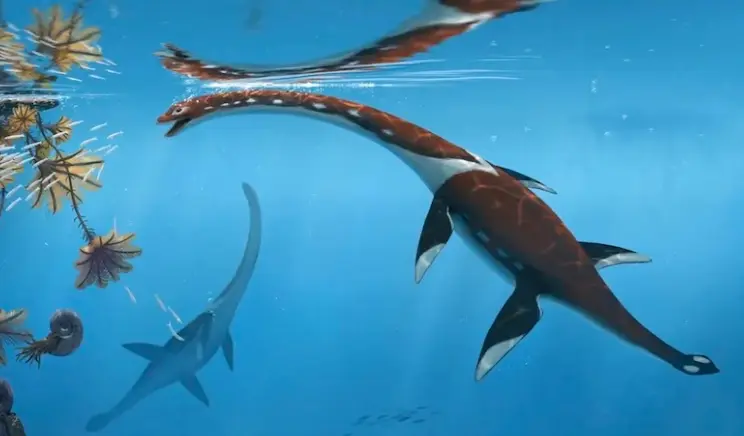
More than 183 million years ago, strange creatures ruled the oceans of Earth. One of these ancient animals has now been identified as a completely new species. Plesionectes longicollum is the name scientists have given to a previously unknown Jurassic marine reptile discovered in Germany.
This remarkable fossil offers scientists a rare glimpse into life in the oceans during the Early Jurassic period. The discovery also reveals that prehistoric seas were far more diverse than researchers once believed.
Plesionectes longicollum lived during the Early Jurassic period, around 183 million years ago. Scientists say this reptile swam through ancient oceans at a time when dinosaurs dominated life on land.
The name Plesionectes longicollum means “long-necked near swimmer.” It belongs to a group of marine reptiles known as plesiosauroids, animals famous for their long necks and powerful swimming abilities.
Plesiosauroids were carnivorous reptiles that hunted fish and other sea creatures. With their long necks and streamlined bodies, they were perfectly adapted to life in the water. Many scientists believe they were among the top predators of prehistoric oceans.
The newly identified fossil measures about 3 meters (10 feet) in length, roughly the size of a crocodile. Interestingly, its neck makes up nearly half of its body length, which is one of the key features that helped researchers identify it as a distinct species.
Although the species has only recently been named, the fossil itself is not new. In fact, its bones were first discovered in 1978 in a quarry in Germany.
The fossil came from the Posidonia Shale formation, a geological layer famous for preserving incredibly detailed fossils. The area near the town of Holzmaden in southwestern Germany has produced some of the best-preserved Jurassic fossils in the world.
For decades, the specimen remained in scientific collections without being fully studied. Earlier researchers suspected it might belong to a known species, so it did not receive detailed attention at the time.
However, a closer examination revealed something surprising.
Vertebrate paleontologist Sven Sachs, the lead author of the study, explained that the fossil had unique anatomical features that had previously been overlooked. When scientists carefully analyzed the skeleton, they realized it represented a completely new genus and species.
An Exceptionally Preserved Skeleton
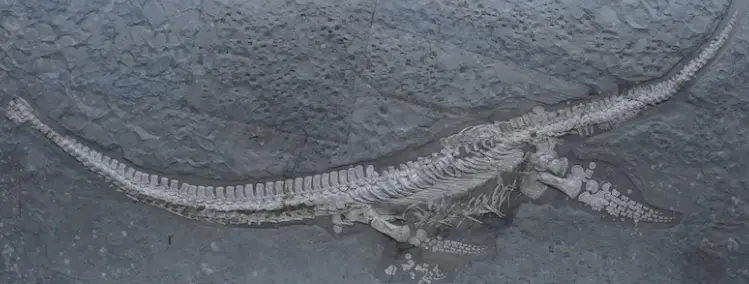
One of the most exciting aspects of the discovery is the exceptional preservation of the fossil.
The skeleton is nearly complete and includes not only bones but also traces of fossilized soft tissue. This level of preservation is rare and gives scientists valuable information about how the animal looked and lived.
Because so much of the skeleton survived, researchers were able to examine the structure of the vertebrae, limbs, and skull in detail. These features clearly separated the animal from other known plesiosaurs.
This helped scientists confidently classify it as a new species rather than a variation of an existing one.
One of the Oldest Plesiosaurs From Holzmaden
The fossil is also important because it represents one of the oldest known plesiosaur specimens from the Holzmaden region.
At the time of its death, the animal had not yet reached full adulthood. Despite this, its skeletal features were clear enough for scientists to identify its unique characteristics.
Researchers have also identified five additional skeletons related to Plesionectes within the Posidonia Shale deposits. These specimens represent members of three major branches of the plesiosaur family tree.
This suggests that marine reptile diversity in the region was much higher than previously thought.
The time when Plesionectes longicollum lived was a period of major environmental changes in Earth’s oceans.
According to paleobiologist Daniel Madzia, a co-author of the study, the Early Jurassic was marked by a significant oceanic anoxic event. During this event, oxygen levels in seawater dropped dramatically.
This caused serious problems for marine life.
Low oxygen levels and increasing ocean acidity led to widespread extinctions in the seas. Scientists estimate that around 5 percent of global families of organisms disappeared during this time.
Despite these harsh conditions, some species survived and adapted. Discoveries like Plesionectes longicollum help scientists understand how marine ecosystems changed and recovered during this difficult period in Earth’s history.
Each fossil adds another piece to the puzzle of how life evolved in ancient oceans.
Why This Discovery Matters
At first glance, naming a new prehistoric reptile might seem like a small step in science. But discoveries like this are actually very important.
Every new species helps scientists:
- Understand the evolution of marine reptiles
- Reconstruct ancient ecosystems
- Track how species adapted to environmental crises
- Learn more about the diversity of life in prehistoric oceans
The discovery also highlights the importance of museum collections. Sometimes fossils sit in storage for decades before new techniques or fresh perspectives reveal their true significance.
Without careful re-examination, this species might have remained unknown forever.
Where the Fossil Is Today
Today, the fossil of Plesionectes longicollum is permanently displayed at the State Museum of Natural History in Stuttgart, Germany.
Visitors to the museum can see the skeleton and learn about the prehistoric oceans that once covered much of Europe.
The fossil stands as a reminder that even after centuries of scientific exploration, our planet still holds many secrets about its distant past.
The Oceans of the Jurassic Still Have Stories to Tell
The discovery of Plesionectes longicollum shows that even well-studied fossil sites can still surprise scientists.
The Posidonia Shale formation continues to reveal new species and new insights into life during the Jurassic period. With modern technology and careful research, scientists are revisiting old fossils and finding hidden details that earlier researchers missed.
As paleontology advances, more ancient creatures will likely be discovered in museum collections and rock layers around the world.
For now, Plesionectes longicollum joins the growing list of fascinating marine reptiles that once ruled Earth’s oceans long before humans appeared.
And its story reminds us that the deep past still has many mysteries waiting to be uncovered.