James
James
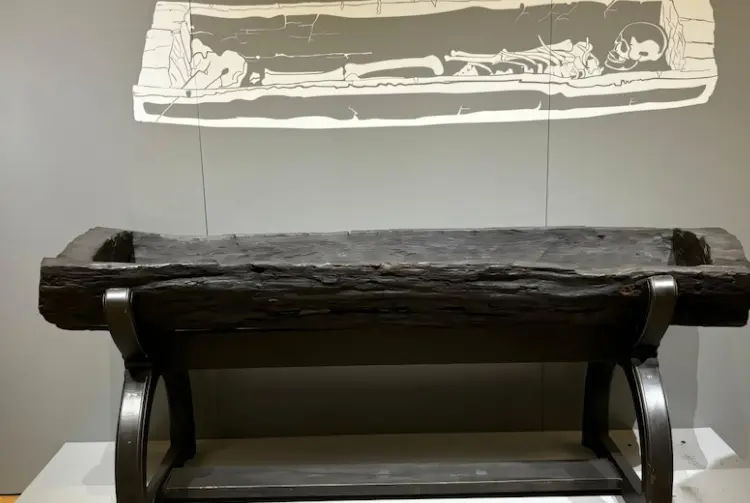
Roman princess coffin dating has finally solved a mystery that puzzled archaeologists for more than a century. A wooden log coffin discovered in Poland after falling from an eroding cliff has now been precisely dated, revealing new details about life during the Roman period in Central Europe.
The unusual burial, often referred to as the “Bagicz Princess,” was first discovered in 1899 in the village of Bagicz in northwestern Poland. For decades, archaeologists debated exactly when the woman inside the coffin lived. Different scientific analyses produced conflicting results, leaving historians uncertain about the real timeline.
Now, thanks to modern dendrochronological analysis — a method that studies tree rings — scientists believe they have finally determined the age of the coffin and the likely time of the woman’s death.
The results provide rare insights into burial traditions and daily life during the Roman Iron Age.
Discovery of the Bagicz Princess
The mysterious burial was uncovered more than 120 years ago after a wooden coffin rolled down an eroding seaside cliff near Bagicz. When archaeologists examined the find, they realized it was highly unusual.
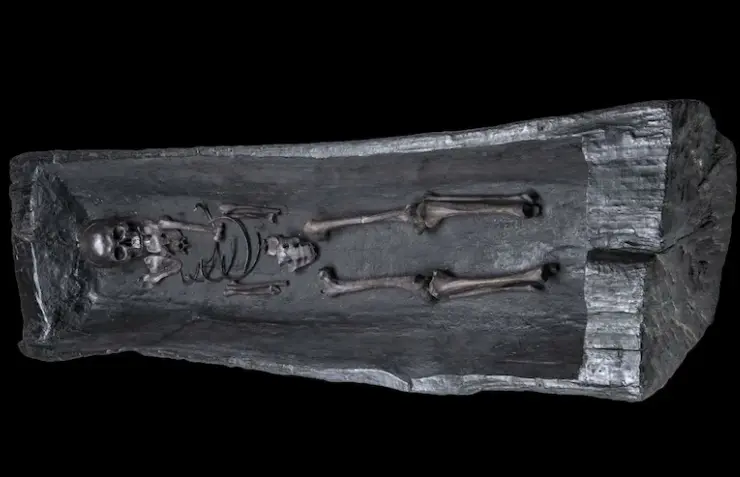
Inside the coffin was the skeleton of an adult woman placed carefully on a cowhide. She had been buried with several valuable objects, including:
- A bronze pin
- A necklace made of glass and amber beads
- Two bronze bracelets
Because of the richness of the burial and its rare preservation, researchers began referring to the woman as the “Bagicz Princess.”
However, the nickname does not necessarily mean she was royalty. It was simply used to highlight the importance and uniqueness of the burial.
A Rare Wooden Log Coffin
Wooden coffins from ancient periods rarely survive because wood usually decomposes quickly in the ground. The Bagicz coffin is therefore considered extremely rare.
Researchers say the coffin is particularly special because both the coffin and its lid were carved from a single oak tree trunk. This type of burial container is known as a log coffin.
The reason the coffin survived for so long is likely due to the wet and damp soil conditions where it was buried. These environmental conditions slowed the decomposition of organic materials such as wood and leather.
According to archaeologists, this is the only known wooden sarcophagus from the Roman Iron Age in Poland that has survived to modern times.
Conflicting Dates Created a Scientific Puzzle
For many years, archaeologists tried to determine when the woman died.
During the 1980s, experts examined the burial objects and concluded that the woman likely lived between AD 110 and AD 160. This dating was based on the style of the jewelry and other artifacts found in the grave.
However, a 2018 radiocarbon analysis of the woman’s tooth produced a very different result. That test suggested she lived between 113 BC and AD 65.
This created a major contradiction. According to the radiocarbon result, the woman appeared to be much older than the objects buried with her.
Scientists needed a new method to solve the puzzle.
Tree-Ring Analysis Finally Reveals the Truth
To resolve the dating conflict, a research team led by archaeologist Marta Chmiel-Chrzanowska conducted a new analysis using dendrochronology, the scientific study of tree growth rings.
Researchers took a small wood sample from the coffin and compared its tree-ring pattern with established chronological records from northwestern Poland.
The results were clear.
Scientists determined that the oak tree used to make the coffin was cut around AD 120. Because wooden coffins were typically made soon after the tree was cut, the burial likely occurred around the same time.
This finding strongly supports the earlier archaeological estimate based on burial objects.
In other words, the woman probably died in the early second century AD, during the Roman Iron Age.
Why the Radiocarbon Dating Was Incorrect
With the coffin now dated to around AD 120, researchers believe the earlier radiocarbon test on the tooth must have been inaccurate.
The most likely explanation is a phenomenon known as the “marine reservoir effect.”
This effect occurs when people consume large amounts of seafood. Marine organisms contain carbon that appears much older than carbon found on land because ocean carbon circulates more slowly.
As a result, radiocarbon tests on humans who ate a lot of fish or marine foods can produce dates that are hundreds of years older than their true age.
Scientists say this effect can sometimes cause dating errors of up to 1,200 years.
It is possible that the Bagicz woman regularly consumed fish or other aquatic food sources, which could explain why her tooth appeared much older than the coffin and burial objects.
Part of the Wielbark Culture
The burial was part of a larger cemetery connected to the Wielbark culture, a group associated with early Gothic populations in Central and Eastern Europe.
The Wielbark culture existed roughly between the 1st and 4th centuries AD and is known for distinctive burial traditions, including the use of wooden coffins and rich grave goods.
According to researchers, the Bagicz burial offers a rare glimpse into funeral practices of this culture, especially because organic materials like wood and leather rarely survive.
The discovery helps archaeologists better understand how people from this society honored their dead.
Was the “Princess” Really Royal?
Although the woman is widely called the Bagicz Princess, archaeologists now believe she may not have been royalty at all.
Paleopathological studies of her skeleton revealed signs of osteoarthritis, even though she was only between 25 and 35 years old when she died.
This suggests she may have performed physically demanding work, which would be unusual for someone from a very high social class.
Because of this, researchers now think the woman may have simply been a typical member of the Wielbark culture, rather than a princess.
DNA Testing May Reveal More Secrets
Even though the mystery of the coffin’s age has finally been solved, many questions about the woman remain unanswered.
Researchers still do not know:
- Her exact ancestry
- Her cause of death
- Whether she had relatives buried nearby
To learn more, archaeologist Marta Chmiel-Chrzanowska plans to conduct new DNA testing on the skeleton.
Previous attempts to extract DNA were unsuccessful, but researchers are now planning a more careful method. They hope to obtain a sample from the temporal bone of the skull, which often preserves DNA better than other bones.
If the analysis succeeds, it could reveal genetic information about the woman and the population she belonged to.
A Rare Window Into the Roman Iron Age
The discovery and dating of the Bagicz coffin highlight how modern scientific methods continue to transform archaeology.
By combining tree-ring analysis, radiocarbon dating, and archaeological research, scientists were able to finally solve a mystery that lasted more than a century.
The burial offers a rare and valuable glimpse into the lives and customs of people living in Roman-era northern Europe.
And with future DNA studies planned, the story of the so-called Bagicz Princess may soon reveal even more secrets from the ancient past.