James
James
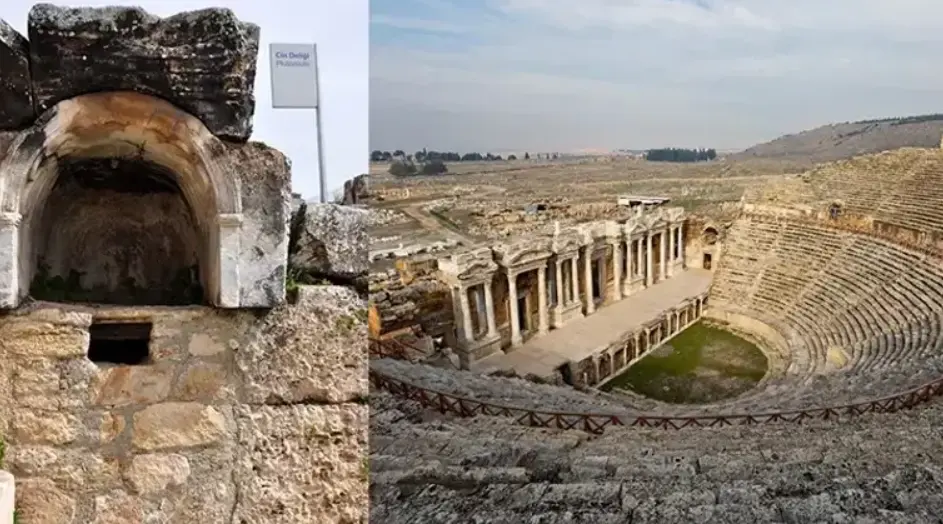
Pluto’s Gate Hierapolis has haunted historians, archaeologists, and travelers for centuries. Located in the ancient city of Hierapolis near modern-day Denizli, Türkiye, this site—long known as the “Gate to Hell”—was feared in antiquity as a place where death struck without warning. Now, after thousands of years of speculation, modern science has finally explained the deadly phenomenon behind the legend.
Recent geological and biological studies conducted by international researchers have revealed that the mysterious deaths described by ancient writers were not the result of divine punishment or supernatural forces. Instead, they were caused by a naturally occurring but extremely dangerous concentration of carbon dioxide gas rising from deep beneath the Earth’s surface.
This discovery not only confirms ancient historical accounts but also shows how accurately early civilizations observed and interpreted natural phenomena—albeit through the lens of mythology.
An Ancient City Built on a Dangerous Fault Line
Pluto’s Gate Hierapolis is located within the ruins of Hierapolis, a Greco-Roman city founded in the 2nd century BCE. The city was built near powerful geothermal springs, which made it both prosperous and perilous. These same geological forces that created healing thermal waters also produced lethal underground gas emissions.
Ancient Romans referred to the cave as Plutonium, believing it to be an entrance to the underworld ruled by Pluto, the god of the dead. According to historical texts, animals brought into the cave would collapse and die within moments, while priests appeared strangely immune.
For centuries, this contradiction puzzled scholars. Why did bulls and birds die instantly, while humans—particularly priests—seemed untouched?
Scientific Measurements Reveal a “Lake of Death”
The mystery of Pluto’s Gate Hierapolis was finally unraveled through detailed scientific measurements led by a research team from the University of Duisburg-Essen in Germany. Biologist Professor Dr. Hardy Pfanz and his colleagues conducted extensive air-quality analyses inside and around the cave.
What they found was startling.
Carbon dioxide (CO₂), a gas heavier than oxygen, was seeping continuously from a seismic fracture directly beneath the cave. During nighttime hours, when temperatures drop and air circulation slows, the gas accumulated near the ground, forming an invisible “lake” of death.
Measurements showed CO₂ concentrations reaching up to 91 percent at ground level—a level instantly fatal to most living beings.

Why Animals Died but Humans Survived
One of the most fascinating aspects of Pluto’s Gate Hierapolis is how ancient priests appeared to survive rituals conducted at the cave. The explanation lies in basic physics and human observation.
Carbon dioxide settles close to the ground. Small animals such as birds, rodents, and even large bulls inhaled the gas almost immediately. Humans, standing upright, were often above the most concentrated layer of CO₂.
Additionally, priests likely knew when gas levels were lower—especially during daylight hours—and may have held their breath or stayed only briefly within the danger zone. What appeared to be divine protection was actually a combination of experience, timing, and natural gas behavior.
A Nighttime Death Trap Still Active Today
The danger of Pluto’s Gate Hierapolis is not confined to ancient history. According to archaeologist Dr. Andrew Wilson of Oxford University, the site remains hazardous even today.
Wilson has observed that small birds flying near the cave entrance can still drop dead within seconds if they pass through the dense CO₂ layer. The geothermal activity beneath Hierapolis has never stopped, meaning the same deadly process continues thousands of years later.
This makes the site one of the rare places on Earth where an ancient myth can still be physically experienced—though safely restricted to researchers.
Not Divine Wrath, but Geological Reality
Ancient cultures lacked modern scientific tools, yet their observations were remarkably accurate. The belief that Pluto’s Gate Hierapolis was an entrance to the underworld stemmed from repeated, undeniable evidence of sudden death.
Professor Pfanz explained that what ancient people described as “Pluto’s breath” was, in reality, magmatic carbon dioxide released directly from the Earth’s crust through an active fault line.
“This was not a supernatural curse,” Pfanz stated. “It was a purely geogenic poisoning process.”
How Myth, Religion, and Science Intersect
The story of Pluto’s Gate Hierapolis demonstrates how mythology often arises from misunderstood natural events. To ancient Romans, unexplained death demanded a divine explanation. Over time, religious rituals formed around the cave, reinforcing its fearsome reputation.
Priests used the site to demonstrate supposed divine favor, strengthening their authority and the spiritual significance of Hierapolis as a sacred city.
Modern science does not diminish this cultural history. Instead, it enriches it by showing how humans across eras attempt to make sense of the same natural forces.
Why This Discovery Matters Today
Understanding Pluto’s Gate Hierapolis is more than solving an ancient mystery. It offers valuable insights into:
- Volcanic and seismic gas emissions
- The dangers of carbon dioxide accumulation
- How ancient societies interacted with hazardous environments
- The scientific basis behind enduring myths
It also serves as a reminder that invisible natural threats still exist today, particularly in volcanic and geothermal regions around the world.
A Rare Case Where History Was Right
Ancient writers claimed that “every living creature entering the cave died instantly.” For centuries, this was dismissed as exaggeration or legend. Now, scientific evidence confirms that these accounts were remarkably accurate.
Pluto’s Gate Hierapolis stands as one of the rare historical sites where mythology, archaeology, and geology intersect perfectly—each validating the other.