James
James
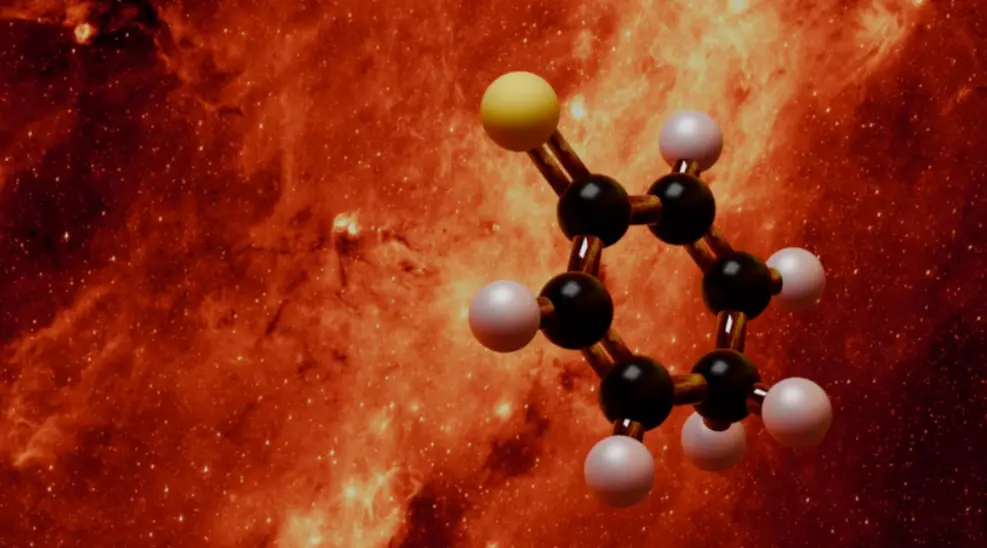
Missing Link Space Life Chemistry may finally have been uncovered after scientists detected the largest sulfur-containing organic molecule ever found in interstellar space. The discovery suggests that some of the chemical foundations of life may have formed long before planets like Earth even existed.
The newly identified molecule was detected in deep space and is being described by researchers as a long-sought “missing link” in understanding how life-forming chemistry develops beyond our planet.
Largest Sulfur-Based Organic Molecule Ever Found
According to research published in Nature Astronomy, the molecule contains 13 atoms, including sulfur, carbon, and hydrogen—elements that are essential for biological processes as we know them.
The study’s lead author, Mitsunori Araki from the Max Planck Institute for Extraterrestrial Physics in Germany, explained that while sulfur is widespread across the universe, large sulfur-bearing organic molecules have remained surprisingly elusive.
For decades, scientists struggled to understand why complex sulfur chemistry appeared underrepresented in space despite sulfur’s abundance. This discovery helps close that gap.
Found Near the Heart of the Milky Way
The molecule was detected inside a massive molecular cloud known as G+0.693–0.027, located roughly 27,000 light-years from Earth, near the center of the Milky Way galaxy.
Molecular clouds like this one are often called “cosmic nurseries” because they are regions where new stars and planetary systems are born. Scientists believe that the chemical compounds forming inside these clouds can later be delivered to planets through comets, asteroids, and cosmic dust.
This process may explain how early Earth acquired many of the chemical ingredients needed for life.
How Scientists Confirmed the Discovery
To verify the molecule’s existence, researchers first recreated it in laboratory conditions. They then measured its unique radio frequency signature, often referred to as a molecular “fingerprint.”
This fingerprint was compared with observational data collected by the IRAM 30-meter telescope and the Yebes Radio Telescope in Spain. When the signatures matched perfectly, scientists were able to confirm that the molecule truly exists in interstellar space.
Why This Discovery Matters
Experts not involved in the study say the implications are significant.
Kate Freeman, a geoscientist at Penn State University, noted that the discovery could help explain the origin of complex sulfur compounds found in meteorites, which have long puzzled researchers.
Meanwhile, Sara Russell from London’s Natural History Museum suggested that the finding strengthens the idea that life-friendly chemistry may exist throughout the galaxy, not just in our solar system.
Clues About the Origins of Life
Sulfur plays a vital role in many biological systems, including proteins and enzymes. Finding complex sulfur-based molecules in space supports the idea that prebiotic chemistry may begin long before planets form.
Rather than life’s building blocks forming exclusively on Earth, scientists increasingly believe that many of these ingredients were assembled in space and later delivered to young planets.
This discovery adds weight to theories suggesting that life’s chemistry has cosmic roots, shaped in the cold, dense environments between the stars.
What Comes Next
Researchers say this finding is likely just the beginning. If such a large sulfur-containing molecule can exist in interstellar space, even more complex compounds—including amino-acid-like structures—may also be waiting to be discovered.
Future observations using next-generation telescopes could reveal an even richer chemical universe, bringing scientists closer to answering one of humanity’s oldest questions: Where did life really begin?