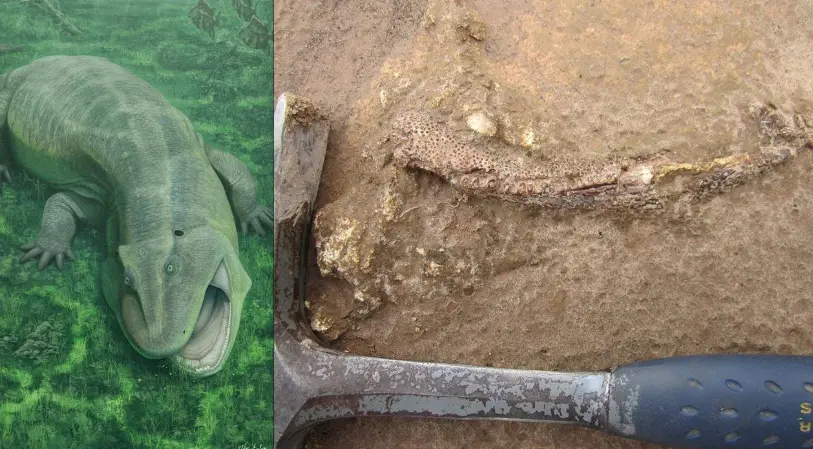
Tanyka amnicola is the name scientists have given to a strange prehistoric creature that lived about 275 million years ago. The unusual species caught researchers’ attention because of its twisted lower jaw and sideways-facing teeth, features rarely seen in known ancient animals.
The discovery was officially announced in a scientific study published on March 4 in the journal Proceedings of the Royal Society B. According to researchers, the creature was so unusual that it may have represented an ancient lineage that survived long after similar species disappeared.
Even in its own time, scientists say Tanyka amnicola may have been a kind of “living fossil.”
An Ancient Relative of Early Tetrapods
Researchers believe Tanyka amnicola belonged to an early group of vertebrates known as tetrapods, animals with four limbs. Today, this massive evolutionary group includes reptiles, birds, mammals, and amphibians.
However, when Tanyka amnicola lived during the Permian Period, many early tetrapod lineages had already gone extinct. That is what makes this discovery so fascinating: the species appears to represent a very old evolutionary branch that somehow survived longer than scientists expected.
Lead author Jason Pardo explained that the animal was both ancient and unusual.
He compared it to modern animals that seem out of place in the evolutionary timeline.
According to Pardo, the creature was similar to how the platypus appears today—an animal that seems almost like a living relic from the distant past.
Even while more advanced tetrapods were evolving, Tanyka amnicola continued to exist as a representative of a much older lineage, making it scientifically important for understanding early vertebrate evolution.
Fossils Discovered in Northeastern Brazil
The discovery of Tanyka amnicola is based on nine fossilized lower jaw bones found in northeastern Brazil.
These fossils were uncovered in what researchers believe was once a dry riverbed. Each jaw fossil measures about 15 centimeters (6 inches) long, and their distinctive structure helped scientists identify them as belonging to a previously unknown species.
However, because only lower jaw bones have been found so far, most of the creature’s body structure remains a mystery.
Scientists used comparisons with related animals to estimate what the creature might have looked like. They believe Tanyka amnicola may have resembled a long-snouted salamander.
Based on these comparisons, the animal may have grown to about 90 centimeters (around 3 feet) in length.
The geological environment where the fossils were found also suggests that the species likely lived in freshwater habitats such as lakes or slow-moving rivers, meaning it probably had a mostly aquatic lifestyle.

A Twisted Jaw Unlike Anything Scientists Have Seen
The most surprising feature of Tanyka amnicola is its unusual lower jaw.
When researchers examined the fossilized bones closely, they noticed something extraordinary: the jaw was twisted, causing the teeth to point sideways instead of upward.
This structure is highly unusual among tetrapods and immediately raised questions.
At first, scientists wondered whether the fossils had been distorted by geological pressure over millions of years.
But after analyzing all nine jaw bones, they realized something important.
Every single fossil showed the same twisted structure.
Jason Pardo explained that the team spent years trying to determine whether the twist was a fossilization artifact or part of the animal’s anatomy.
Eventually, they concluded that the unusual shape was completely natural and an authentic part of the species’ design.
In addition, researchers discovered that the inner surface of the lower jaw curved upward and contained small tooth-like structures called denticles.
These denticles likely formed a grinding surface, suggesting that the animal’s feeding style may have been quite different from most early tetrapods.
An Unusual Feeding Strategy
Because of its unique jaw structure, scientists believe Tanyka amnicola may have had a very different diet compared to other early tetrapods.
Many early tetrapods were primarily carnivorous, feeding on other small animals.
However, the presence of denticles and grinding surfaces in the jaw suggests that Tanyka amnicola may have consumed small invertebrates, plant material, or a combination of both.
If this interpretation is correct, it could reveal new information about the diversity of feeding strategies among early vertebrates.
This would also mean that the ecosystems of the Permian period were likely more complex than previously thought.
A Window Into Gondwana’s Ancient Ecosystems
During the time when Tanyka amnicola lived, the region that is now Brazil was part of the massive southern supercontinent known as Gondwana.
Gondwana included areas that are now South America, Africa, Antarctica, Australia, and India.
The discovery of this strange species offers researchers a new opportunity to better understand how ecosystems functioned on Gondwana during the Permian period.
Co-author Ken Angielczyk emphasized that the species could help scientists reconstruct ancient food webs.
According to Angielczyk, fossils like these allow researchers to examine how prehistoric ecosystems were structured and how different species interacted with one another.
By studying animals such as Tanyka amnicola, scientists can begin to piece together a clearer picture of which species lived together, what they ate, and how they survived in ancient environments.
Why This Discovery Matters
The discovery of Tanyka amnicola is important for several reasons.
First, it reveals that ancient evolutionary lineages survived longer than previously believed.
Second, the unusual jaw structure provides evidence that early tetrapods experimented with a wider variety of feeding strategies than scientists once assumed.
Finally, the fossils help researchers better understand the ancient ecosystems of Gondwana, one of the most important landmasses in Earth’s geological history.
Although the fossils found so far are limited to jaw bones, scientists hope that future excavations in Brazil may uncover additional remains, which could reveal more about this mysterious creature’s anatomy and lifestyle.
For now, Tanyka amnicola remains one of the strangest prehistoric animals discovered in recent years, offering a fascinating glimpse into life nearly 275 million years ago.
Leave a Reply