James
James
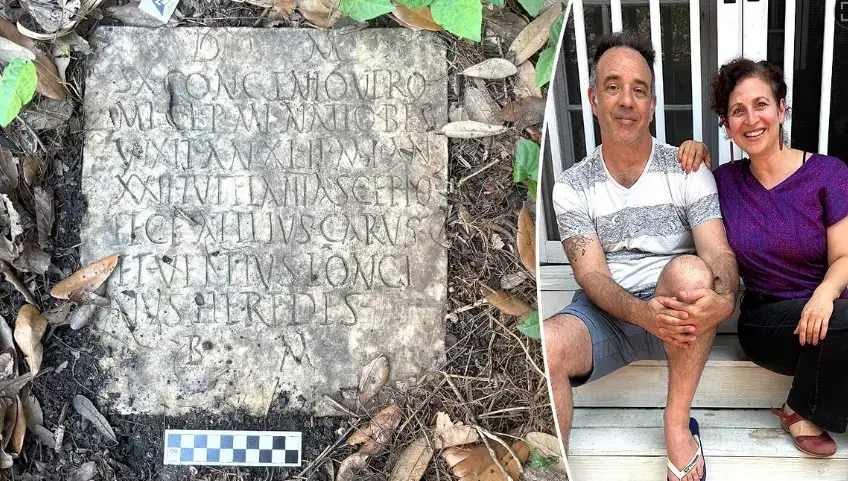
2,000-Year-Old Roman Treasure found in a backyard in New Orleans is capturing the attention of historians and archaeologists alike. What seemed like an ordinary piece of marble decoration turned out to be an extraordinary archaeological relic, shedding light on a story that spans two millennia.
While working on their garden, anthropologist Daniella Santoro and her husband Aaron Lopez noticed a partially buried marble slab in the backyard of their historic home in the Carrollton neighborhood. The Latin inscription on the stone immediately stood out. Santoro said the text made them pause, signaling that this was far from a simple decorative object.
At first glance, the slab appeared to be a decorative replica, but the Latin script hinted at something much deeper. Following their instincts, the couple reached out to experts. A team including archaeologist Susann Lusnia from Tulane University and anthropologist D. Ryan Gray from New Orleans University began examining the slab.
Unearthing a Roman Soldier’s Story
The inscription began with the familiar Roman phrase Dis Manibus, a traditional dedication to the spirits of the dead. Translating the text revealed that the stone was a tomb marker for a Thracian Roman soldier named Sextus Congenius Verus. It detailed that he had died at the age of 42 after 22 years of military service. The tomb was commissioned by his heirs, Atilius Carus and Vettius Longinus.
This Roman soldier’s memorial, dating back nearly 1,900 years, had mysteriously ended up in a Louisiana backyard, thousands of miles from its original location.

From Italy to Louisiana: A Journey Through History
Investigations traced the stone back to the early 20th century, when it was cataloged in the National Archaeology Museum of Civitavecchia, Italy. During World War II, the museum suffered heavy damage, and many artifacts were lost or displaced across Europe.
The marble slab’s dimensions matched museum records, and previous owners confirmed that it had been brought to the U.S. by Charles Paddock Jr., an American soldier who had served in Italy. The family apparently placed it in the garden, unaware of its historical significance.
Returning History to Its Roots
After decades, the FBI Art Crime Team coordinated efforts to return the tombstone to its place of origin. Plans are underway to restore this remarkable piece of history to the lands where Sextus Congenius Verus once served, reconnecting a modern discovery with ancient Rome.
This unexpected backyard find reminds us how history can resurface in the most ordinary of places, waiting to tell stories that span centuries.