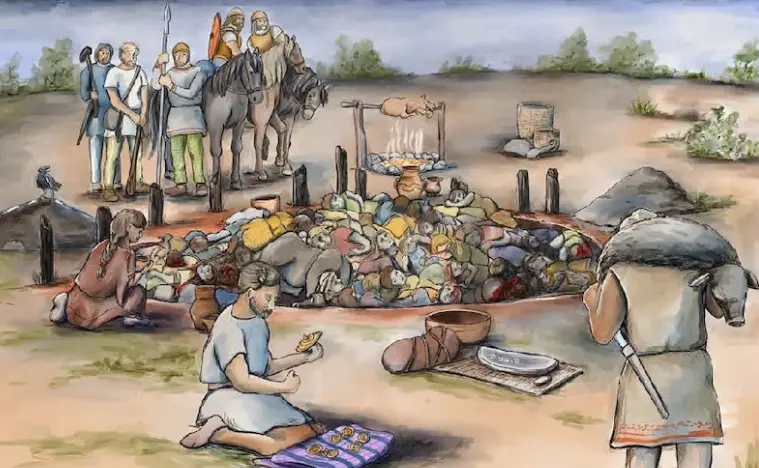

2,800-Year-Old Mass Grave evidence is shedding disturbing new light on violence in Early Iron Age Europe. Archaeologists studying a burial site in northern Serbia have uncovered the remains of women and children who were violently killed nearly three millennia ago, pointing to a calculated act of mass violence rather than an isolated conflict.
The discovery was made at the Gomolava site, close to the modern town of Hrtkovci in northern Serbia. Gomolava was first settled in the sixth millennium BCE along the Sava River and remained an important location for thousands of years. By the 9th century BCE, the region had become a hotspot of tension as semi-sedentary groups moved through the Carpathian Basin, competing for land, resources, and control.
A Small Pit With a Shocking Story
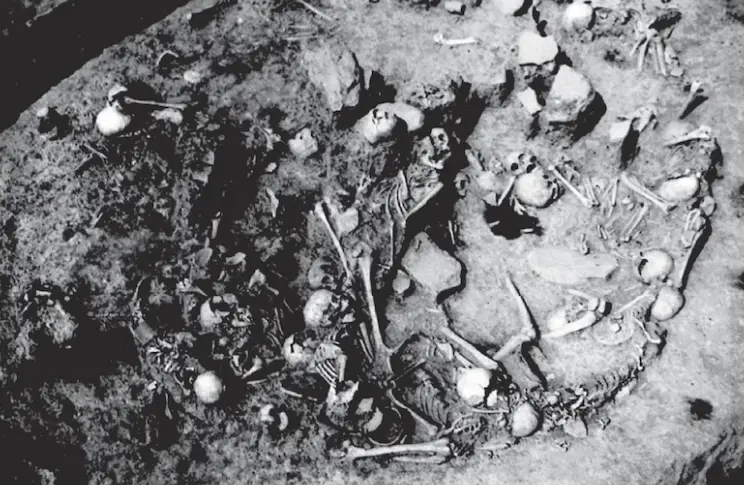
Researchers focused on a relatively small burial pit measuring just 2.9 meters wide and 0.5 meters deep. Despite its size, the pit contained the skeletal remains of 77 individuals, along with pottery, bronze ornaments, and the bones of nearly 100 animals. At the very bottom, archaeologists found the complete skeleton of a young cow, suggesting the burial had ritual significance.
What truly shocked researchers was the demographic makeup of the victims. Over 70% were women, and 69% were children, a pattern described by experts as extremely rare in prehistoric Europe. According to the researchers, this challenges long-held assumptions that ancient mass killings mainly involved adult men.
Clear Evidence of Extreme Violence
Detailed examination of the skulls revealed extensive signs of intentional, lethal trauma, primarily caused by blunt force blows delivered at close range. The placement of the injuries suggests the attackers may have been taller than the victims or possibly mounted on horses. There is no evidence of defensive wounds, which implies the victims were unable to resist.
The study, published in Nature Human Behaviour, describes the violence as deliberate, systematic, and highly effective. Researchers emphasize that this was not random chaos but a controlled act with a clear purpose.
Not One Family, But Many
DNA analysis showed that only a small number of the individuals were closely related. This means the grave does not represent a single extended family or household wiped out in a raid. Strontium isotope analysis of tooth enamel further revealed that more than one-third of the victims grew up outside the Gomolava region, indicating a mixed and mobile population.
Lead author and bioarchaeologist Linda Fibiger explained that the site likely became a focal point where captured women and children from different groups were brought and killed. However, there is no archaeological evidence suggesting the victims were held captive for long periods before their deaths.
Violence as a Strategy
Archaeologists believe the killings were tied to growing tensions over land ownership and settlement patterns during the Early Iron Age. As mobile and settled communities collided, conflicting ideas about territory may have led to forced displacement, targeted killings, and the deliberate destruction of social continuity.
Women and children were vital to the survival of ancient communities. Their systematic killing would have effectively cut off family lineages, preventing future generations and weakening rival groups. A second mass grave discovered at Gomolava in 1954, also dominated by female remains, supports the idea that this was not a one-time event.
A Grim Message From the Past
Taken together, the killings, burial rituals, and possible monument markers suggest an intentional display of power. Researchers conclude that this act was meant to resolve conflict through fear and domination, reshaping social structures and asserting control.
The 2,800-Year-Old Mass Grave at Gomolava stands as one of the clearest examples of organized mass violence in prehistoric Europe, reminding us that strategic brutality existed long before written history.

0 Comments