James
James
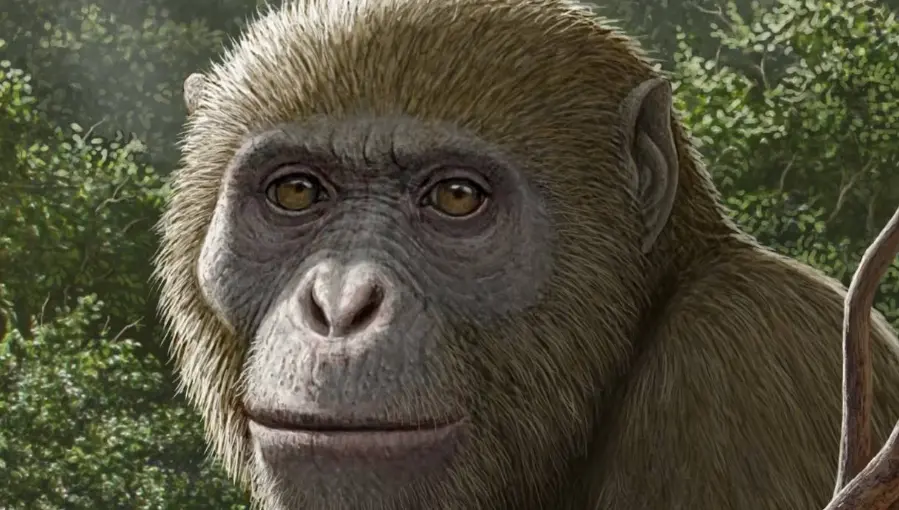
Egypt Fossil Monkey Origin Discovery is reshaping what scientists thought they knew about the origins of apes. A newly identified fossil species discovered in Egypt suggests that the ancestors of modern apes—including humans—may not have originated solely in East Africa, as long believed.
Instead, this remarkable find points toward a different possibility: that early ape evolution may have taken place further north, in regions such as northeast Africa or even the Arabian Peninsula. This challenges decades of scientific assumptions and opens the door to a new understanding of our evolutionary past.
Meet Masripithecus moghraensis
At the center of this discovery is a newly identified species called Masripithecus moghraensis. The fossil remains, dated to around 17–18 million years ago, were uncovered in the Wadi Moghra region of northern Egypt during fieldwork conducted between 2023 and 2024.
Although the fossil evidence is limited—consisting mainly of fragments of a lower jaw and worn teeth—researchers determined that these remains did not belong to any previously known species. This led to the classification of a completely new genus and species.
The name itself reflects its origins: “Masri” refers to Egypt, while “pithecus” is derived from Greek, meaning ape. The species name “moghraensis” honors the location where the fossil was found.
A Shift Away from East Africa?
For many years, scientists believed that modern apes evolved primarily in East Africa. This theory was based on fossil evidence found in countries like Kenya and Ethiopia, where several early ape fossils closely related to modern species had been discovered.
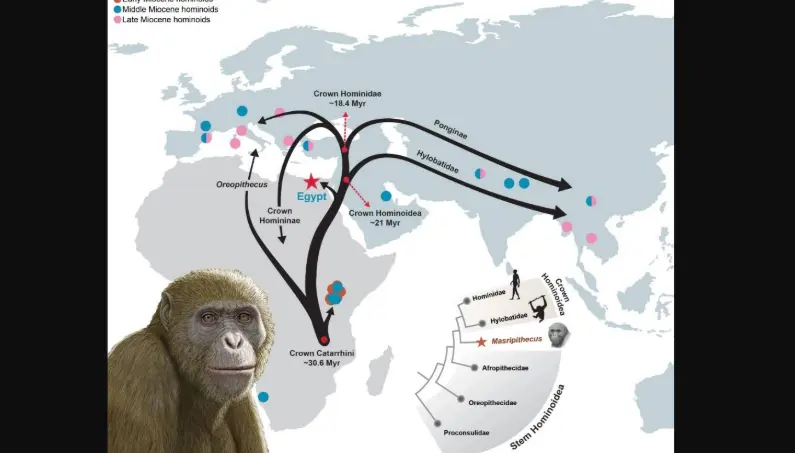
However, the new findings published in Science suggest a different narrative. According to the study, Masripithecus moghraensis may sit very close to the evolutionary branch that led to all living apes.
This means it could be closely related to the last common ancestor shared by:
- Great apes (including humans, chimpanzees, and gorillas)
- Lesser apes (such as gibbons and siamangs)
If this interpretation is correct, it implies that this common ancestor may have lived in northern Afro-Arabian regions rather than exclusively in East Africa.
What the Fossils Reveal
To understand where this species fits in the evolutionary tree, researchers analyzed:
- Fossil age comparisons
- Dental and jaw structure
- Genetic data from modern apes
Despite the fragmentary nature of the fossils, teeth and jawbones are among the most informative parts of the skeleton in paleontology. They provide crucial insights into diet, behavior, and evolutionary relationships.
According to lead researcher Shorouq Al-Ashqar, this discovery highlights how incomplete the fossil record still is. Finding an ape fossil in this region was both surprising and significant, suggesting that many more discoveries may still be waiting beneath the surface.
Scientific Debate Continues
Not all experts are fully convinced by the conclusions. Some scientists argue that the evidence is too limited to redraw the evolutionary map just yet.
For example, biological anthropologist Sergio Almécija described the interpretation as somewhat speculative. He emphasized the need for more complete fossil remains before making major revisions to established theories.
Still, other researchers, including Erik Seiffert, support the idea that early apes may have lived in northern regions of the Afro-Arabian landmass. This perspective is also partially supported by fossil evidence showing that ancient apes once inhabited parts of Western Asia.
Why This Discovery Matters
This discovery is important for several reasons:
1. It Expands the Geographic Map of Evolution
The finding suggests that ape evolution may not have been limited to East Africa. Instead, a broader region—including North Africa and Arabia—may have played a key role.
2. It Challenges Long-Held Assumptions
For decades, textbooks have pointed to East Africa as the cradle of ape evolution. This discovery forces scientists to reconsider that narrative.
3. It Highlights Gaps in the Fossil Record
The fact that such an important species remained undiscovered until now shows how incomplete our understanding still is.
4. It Opens New Research Opportunities
Regions like northern Egypt may now become major targets for future paleontological excavations.
The Bigger Evolutionary Picture
Today, great apes are found mainly in Africa and Southeast Asia, while lesser apes like gibbons live in South and Southeast Asia. Fossil evidence indicates that ancient apes once had a much wider distribution, including parts of Europe and Asia.
This raises an important possibility: early apes may have migrated across continents more extensively than previously thought. If so, the evolutionary story of apes—and ultimately humans—may be far more complex than current models suggest.
What Comes Next?
Researchers agree that more fossil evidence is needed to confirm these findings. Future excavations in Egypt and surrounding regions could uncover more complete skeletons, providing clearer answers about early ape evolution.
As Al-Ashqar notes, continued exploration in this region has the potential to significantly deepen our understanding of how apes—and by extension, humans—evolved over millions of years.
For now, Masripithecus moghraensis stands as a fascinating clue in a much larger puzzle—one that scientists are only beginning to piece together.