James
James
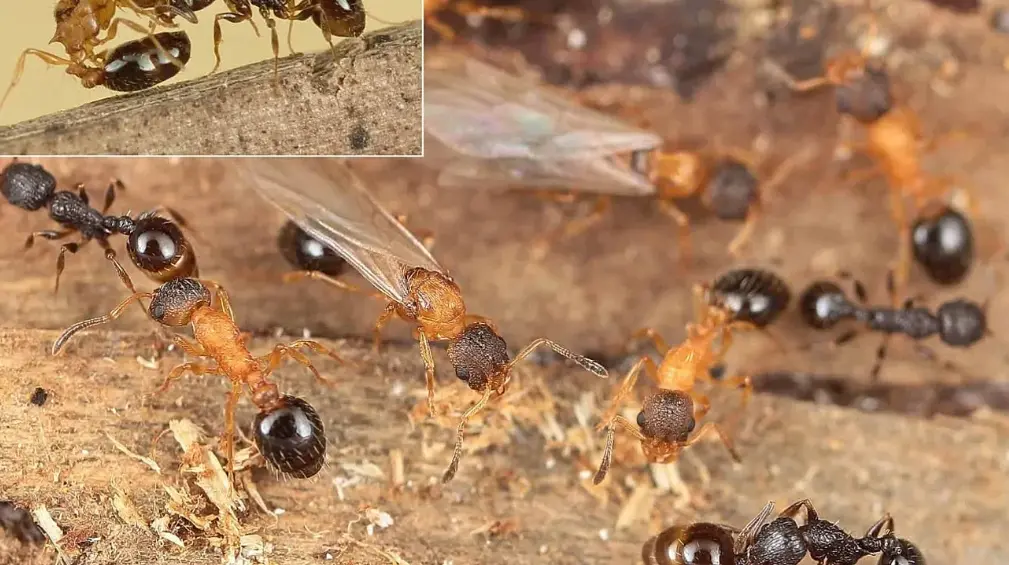
Temnothorax kinomurai is an extraordinary ant species discovered in Japan that challenges everything scientists thought they knew about ant societies. Unlike typical ant colonies that contain queens, workers, and males, this unusual species appears to consist entirely of queens.
Researchers say that every individual ant in the Temnothorax kinomurai species is capable of reproduction. There are no worker ants and no male ants in the colony. This surprising discovery has fascinated scientists because it overturns the long-established model of how ant societies function.
The findings were recently published in the peer-reviewed journal Current Biology after decades of investigation into the species’ unusual behavior and biology.
Temnothorax kinomurai: A Colony Made Only of Queens
The structure of Temnothorax kinomurai colonies is radically different from what is seen in most ant species.
In a typical ant colony:
- A queen lays eggs
- Worker ants maintain the nest and gather food
- Male ants exist mainly for reproduction and usually live short lives
However, the Temnothorax kinomurai species breaks this rule completely. Every individual ant is a reproductive queen.
This means the species has no dedicated workers and no males at all. Instead of maintaining their own workforce, these ants rely on a highly unusual survival strategy: invading the nests of other ant species.
Temnothorax kinomurai Uses a Social Parasite Strategy
Another remarkable feature of Temnothorax kinomurai is its parasitic lifestyle.
Rather than building and maintaining their own colonies, these ants invade nests belonging to a closely related species called Temnothorax makora.
Scientists observed the process in which a young queen from the invading species sneaks into the host colony. Once inside, she attacks the resident queen using her sting and attempts to take control of the nest.
During the takeover, the invading queen may also sting and disable aggressive worker ants that resist her presence.
In some observed cases, the manipulation becomes so extreme that host workers end up killing their own queen, unknowingly helping the invader take full control of the colony.
If the takeover succeeds, the host workers continue performing their usual duties—feeding larvae and maintaining the nest—without realizing they are now raising the offspring of a completely different species.
Temnothorax kinomurai Reproduces Without Males
One of the most surprising discoveries about Temnothorax kinomurai is its method of reproduction.
Scientists studying the ants in laboratory conditions found that the species reproduces through parthenogenesis, a type of asexual reproduction.
In this process, females produce offspring without fertilization by males.
Microscopic examinations revealed that the reproductive organs of the queens showed no evidence of ever being used for mating.
Researchers raised dozens of new ants from these queens under controlled conditions. When the offspring matured, scientists examined their body structures and reproductive organs.
The result was astonishing: every single one of them was also a queen.
In one study group of 43 individuals, not a single worker or male ant appeared.
This confirms that the species is capable of maintaining entire generations composed exclusively of queens.
A Long-Standing Scientific Mystery Finally Explained
For decades, scientists suspected that Temnothorax kinomurai might operate differently from other ants, but proof remained elusive.
The species has been observed only in nine known locations in Japan, making it rare and difficult to study in the wild.
It took roughly 40 years of research for scientists to confirm the true nature of its colony structure and reproductive system.
The final breakthrough came through careful observation, laboratory breeding experiments, and genetic analysis.
The study revealed that this unusual ant species has evolved one of the most extreme forms of social parasitism ever documented among insects.
Temnothorax kinomurai and the Limits of Ant Evolution
Some scientists believe Temnothorax kinomurai may represent an advanced evolutionary stage of parasitic ants.
Professor Jürgen Heinze from the University of Regensburg described the species as potentially representing the “final stage” of social parasitism in ants.
However, this extreme specialization also comes with serious risks.
Because Temnothorax kinomurai depends entirely on the host species Temnothorax makora for survival, its fate is closely tied to that species.
If the host species were to disappear, the parasitic ant would likely vanish as well.
In evolutionary terms, this makes the strategy both fascinating and fragile.
The Genetic Risk of an All-Queen Society
Another question scientists are trying to answer involves the long-term survival of Temnothorax kinomurai.
Sexual reproduction usually increases genetic diversity, helping species adapt to diseases, environmental changes, and new threats.
Because this species reproduces asexually, genetic diversity may be extremely limited.
Without the mixing of genes that normally occurs during reproduction involving males, future generations could become genetically similar to one another.
This raises concerns that the species may struggle to adapt to environmental changes or disease outbreaks over long periods.
Researchers are now studying whether occasional genetic variation might still occur through rare biological mechanisms.
What This Discovery Means for Science
The discovery of Temnothorax kinomurai is significant because it challenges traditional assumptions about social insects.
Ant colonies have long been viewed as highly organized societies with strict divisions of labor. Queens reproduce, workers maintain the colony, and males exist briefly for mating.
But Temnothorax kinomurai shows that evolution can produce entirely different social systems.
A colony composed entirely of reproductive individuals was once considered biologically unlikely, yet this species proves it can exist.
The finding may also help scientists better understand:
- The evolution of parasitic insects
- Alternative reproductive strategies in nature
- The limits of social organization among ants
A Rare Species With Many Unanswered Questions
Although researchers have learned a great deal about Temnothorax kinomurai, many mysteries remain.
Scientists still want to understand:
- How the invading queens locate suitable host nests
- How host workers become manipulated into raising the invader’s offspring
- Whether the species can survive long-term without genetic diversity
Because the ant has only been found in a handful of locations, additional field studies are needed to determine how widespread the species may actually be.
For now, Temnothorax kinomurai stands as one of the most unusual examples of insect social evolution ever documented.
Its all-queen society challenges long-held biological assumptions and reminds scientists that nature often finds unexpected solutions to survival.