Huayuan biota fossils discovered in southern China are giving scientists an unprecedented look at how life recovered after one of the earliest mass extinction events in Earth’s history. Found in a small quarry in Hunan Province, these fossils date back roughly 512 million years, just after a catastrophic die-off that brought the Cambrian explosion to an abrupt halt.
Researchers say the discovery includes nearly 100 previously unknown animal species, preserved in remarkable detail. The find is being described as one of the most important fossil discoveries of the past decade and could reshape scientific understanding of early animal evolution.
A small quarry with an enormous scientific impact
The fossil site is located in Huayuan County, a mountainous region in southern China. Despite its modest size — measuring only about 12 meters high, 30 meters long, and 8 meters wide — the quarry has yielded an astonishing number of fossils.
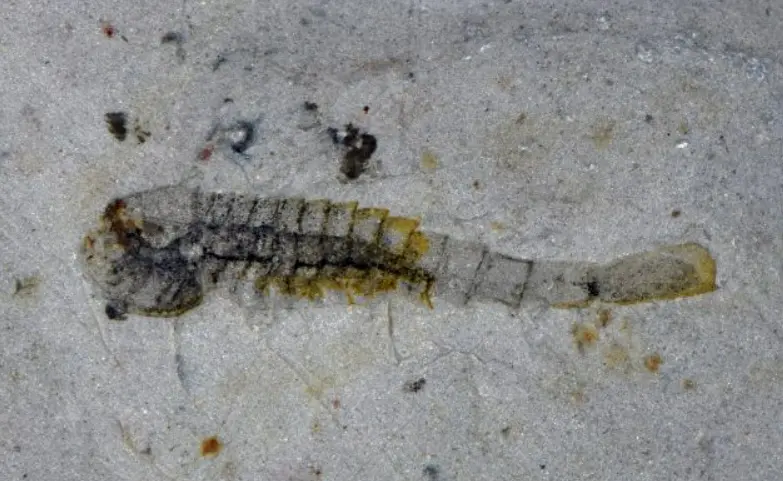
Since excavations began in 2021, scientists have collected more than 50,000 fossil specimens from this single location. Detailed analysis has so far identified 153 different species, with around 60 percent new to science.
According to lead researcher Han Zeng of the Chinese Academy of Sciences, the density and quality of fossils at the site were immediately striking.
“It was an extraordinary place,” Han said, noting that entire animals appeared clearly outlined on the rock surfaces.
Huayuan biota fossils preserve soft tissues rarely seen
What makes the Huayuan biota fossils especially valuable is their exceptional preservation. Unlike many fossil sites that preserve only shells or hard skeletons, these specimens include soft body parts.
Scientists have identified preserved gills, digestive systems, eyes, antennae, walking limbs, and even traces of nervous tissue. This level of detail is extremely rare for fossils of this age.
Researchers believe the animals were buried rapidly by fine mud flows, which sealed them off from oxygen and scavengers, allowing delicate tissues to survive for more than half a billion years.
Ancient relatives of modern animals
The fossil assemblage includes ancient relatives of many groups still alive today. These include early forms of:
- Arthropods, the group that includes insects, spiders, and crustaceans
- Mollusks
- Brachiopods
- Cnidarians, related to jellyfish and corals
- Sponges and worm-like organisms
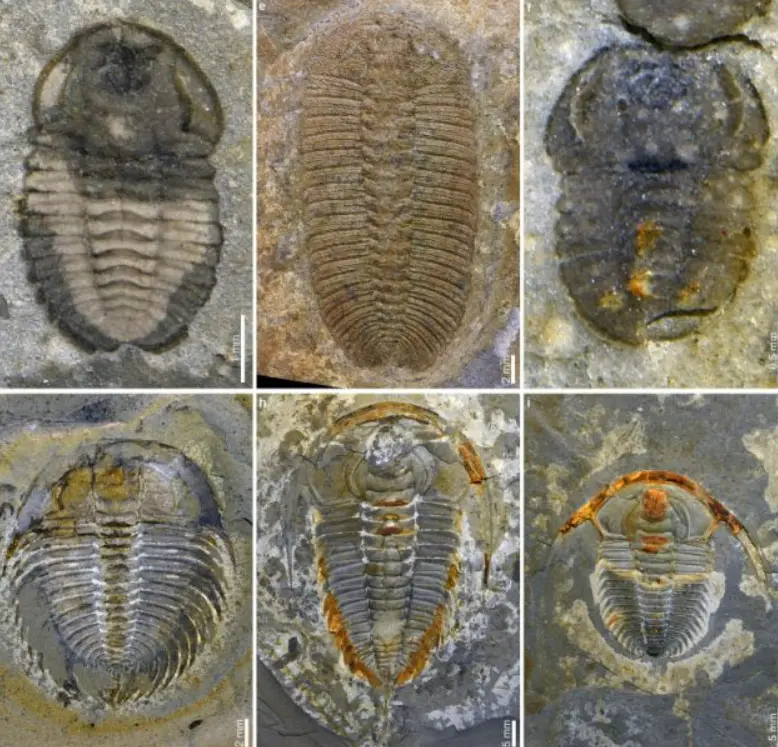
Arthropods dominate the site, reflecting their early evolutionary success. Among them are radiodonts, large, spiny predators with stalked eyes that once sat at the top of the Cambrian food chain.
One standout species, an 80-centimeter-long arthropod, is believed to have been the apex predator of the Huayuan ecosystem.
Why the timing of Huayuan biota fossils matters
The Huayuan biota fossils come from a critical moment in Earth’s history. Around 540 million years ago, life on Earth experienced the Cambrian explosion, a rapid diversification that produced most major animal groups.
This boom was likely driven by rising oxygen levels in the oceans. However, the expansion did not last.
Around 513 million years ago, a mass extinction known as the Sinsk event wiped out up to half of marine animal species. Scientists believe falling oxygen levels played a central role.
The Huayuan fossils date to just after this extinction, making them the first major collection of soft-bodied animals known to have lived in its immediate aftermath.
What Huayuan biota fossils reveal about survival
The fossils suggest that deep-water ecosystems were less affected by the Sinsk event than shallow coastal environments. Many animals in the Huayuan biota appear to have lived along the edge of the continental shelf, in relatively stable conditions.
Evolutionary biologists not involved in the study say this mirrors patterns seen in later extinction events.
Deep-ocean environments tend to experience fewer temperature swings and chemical changes, acting as refuges during global crises.
This may explain how certain animal groups survived while others vanished.
Links between China and Canada’s Burgess Shale
One of the most surprising aspects of the discovery is that some Huayuan species were previously known only from the Burgess Shale in Canada, one of the world’s most famous Cambrian fossil sites.
Species such as Helmetia and Surusicaris were thought to be unique to North America. Their presence in China suggests early animals were capable of long-distance dispersal.
Scientists believe the most likely explanation is that larval forms of these animals drifted across ancient oceans via currents, spreading life across the planet far earlier than previously assumed.
Not one of the ‘Big Five,’ but still devastating
The Sinsk event is not counted among the famous “Big Five” mass extinctions, which include the event that wiped out the dinosaurs 66 million years ago. However, researchers emphasize that it was still profoundly destructive.
Evidence suggests there have been at least 18 mass extinction events over the past 540 million years, many of which remain poorly understood.
Until now, knowledge of the Sinsk event came mainly from fossils of hard-shelled animals like trilobites. The Huayuan biota fossils finally provide insight into how soft-bodied life was affected.
A new benchmark for Cambrian fossil sites
Paleontologists say the Huayuan site now ranks among the top-tier Cambrian fossil localities worldwide, possibly rivaling or even surpassing the Burgess Shale in some respects.
The combination of species diversity, preservation quality, and precise timing makes it a rare scientific resource.
As researchers continue to study the site, more discoveries are expected, including entirely new branches of the animal family tree.
Why Huayuan biota fossils matter today
Beyond their scientific importance, Huayuan biota fossils offer a powerful reminder of how life responds to environmental stress.
They show that while mass extinctions can be devastating, they also reshape ecosystems, opening the door for new forms of life to emerge and spread.
For scientists studying modern biodiversity loss and climate-driven change, these ancient fossils provide valuable context — a deep-time perspective on resilience, adaptation, and survival.
Leave a Reply