James
James
Oldest Ankylosaurus Fossil Reveals Early Evolution of Armored Dinosaurs
Oldest Ankylosaurus fossil discoveries are changing what scientists know about the evolution of armored dinosaurs. A newly analyzed dinosaur skeleton from North Africa suggests that these heavily armored creatures developed their famous tail weapons about 30 million years earlier than previously believed.
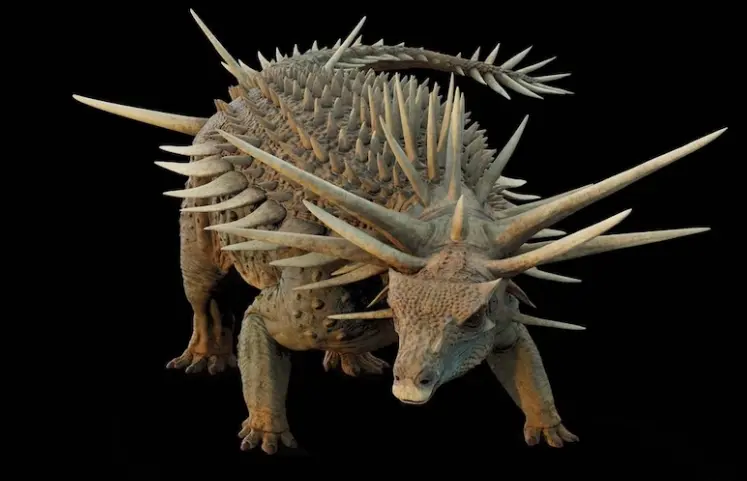
The dinosaur, named Spicomellus afer, lived around 165 million years ago during the Middle Jurassic period. Researchers say the unusual creature was covered in long defensive spikes and thick armor plates that ran across its shoulders and neck. At roughly 4 meters (13 feet) long, it would have been a strange and intimidating sight walking across the ancient floodplains of what is now North Africa.
Scientists now believe this fossil represents the oldest known ankylosaur, providing new clues about how this famous group of dinosaurs evolved.
A Strange Armored Dinosaur From Ancient Africa
Spicomellus afer was unlike any ankylosaur previously discovered. According to researchers, the dinosaur’s body featured large spikes that were directly fused to its bones, something rarely seen in vertebrate fossils.
The spikes around the dinosaur’s neck may have reached almost one meter in length, forming a powerful natural defense system. Combined with the armor plates along its shoulders, this created a protective structure that would have made it extremely difficult for predators to attack.
An artist’s reconstruction of the dinosaur shows a bulky creature walking slowly across muddy floodplains, its body protected by a forest of sharp spikes and armor.
Although ankylosaurs are famous for their club-shaped tails, the fossil evidence suggests that this ancient species may have already begun evolving such weapons much earlier than scientists once thought.
The Discovery Began With a Single Rib Bone
The story behind this discovery began in 2019, when paleontologist Susannah Maidment from the Natural History Museum in London purchased an unusual fossil rib from a fossil dealer in Cambridge, England.
The bone immediately caught her attention because it looked unlike any vertebrate fossil she had seen before. Instead of being smooth, the rib had protective spikes fused directly into the bone surface.
At first, researchers only had this single rib bone to work with. Despite the limited evidence, scientists described a new species called Spicomellus afer in 2021.
However, many questions remained unanswered. Researchers were unsure whether the creature truly belonged to the ankylosaur family.
That uncertainty pushed scientists to search for more fossils.
Field Research in Morocco Brings New Evidence
To better understand the mysterious dinosaur, scientists organized field research in the Middle Atlas Mountains of Morocco. This region is known for its rich fossil deposits from the Jurassic period.
In 2023, researchers made an important breakthrough. They discovered a more complete skeleton from the same rock layer where the original rib bone had been found.
This new fossil confirmed that Spicomellus was indeed an early member of the ankylosaur family.
According to Maidment, the discovery removed the doubts scientists initially had.
When the species was first identified, there was uncertainty about whether it truly belonged to the ankylosaur group. The new skeleton now confirms that classification and shows that Africa’s ankylosaurs were even stranger than researchers expected.
Rethinking Ankylosaur Evolution
Ankylosaurs were large, heavily armored dinosaurs that lived from the Middle Jurassic period until the end of the Cretaceous period. They are known for their thick body armor and powerful club-like tails.
Despite their intimidating appearance, these dinosaurs were slow-moving plant eaters.
Paleontologist Richard Butler, one of the study’s co-leaders, explained that ankylosaurs had relatively small brains compared to their body size. However, they survived for nearly 100 million years, making them one of the most successful dinosaur groups in Earth’s history.
The newly discovered fossil suggests that ankylosaurs evolved their defensive weapons much earlier than scientists previously believed.
Although the tail of Spicomellus was not fully preserved, researchers found fused tail vertebrae, which strongly suggest that the dinosaur had a club-like tail weapon.
If confirmed, this means ankylosaurs may have started evolving their famous tail clubs around 30 million years earlier than scientists thought.
Armor That May Have Been for Display
One of the most surprising aspects of Spicomellus afer is the extremely dramatic armor around its neck.
Researchers believe the spikes may not have been used only for protection.
Instead, they might have played a role in display and competition between individuals. Similar to horns in modern animals, the large spikes could have helped attract mates or intimidate rivals.
Richard Butler noted that the armor around the dinosaur’s neck appears unusually exaggerated. Carrying such heavy armor would have required significant energy, which suggests the structure may have had multiple functions beyond defense.
Over time, as predators evolved and ecosystems changed, ankylosaurs may have simplified their armor to focus more on practical protection rather than display.
Another possibility is that mating strategies changed, causing decorative armor features to become less important.
A Window Into Ancient Dinosaur Diversity
Scientists say this discovery helps researchers better understand the diversity and evolution of ankylosaurs.
Paleontologist Wenjie Zheng from the Zhejiang Natural History Museum in China explained that the fossil provides valuable insight into how these dinosaurs diversified and adapted over time.
The research also highlights the importance of Morocco as a fossil discovery region.
Driss Ouarhache, a paleontologist from Sidi Mohamed Ben Abdellah University in Morocco, emphasized that the country still holds many unexplored fossil sites.
According to Ouarhache, discoveries like Spicomellus afer demonstrate that Morocco’s prehistoric landscapes may contain many more scientific surprises waiting to be uncovered.
Why This Discovery Matters
The discovery of the oldest Ankylosaurus fossil is important because it reshapes scientists’ understanding of dinosaur evolution.
It shows that complex defensive adaptations appeared earlier than expected. It also reveals that early ankylosaurs may have looked very different from their later relatives.
Most importantly, it proves that there is still much to learn about the ancient world.
With continued exploration and research, scientists hope to uncover more fossils that will help piece together the long evolutionary story of armored dinosaurs.
For now, Spicomellus afer stands as one of the most unusual and fascinating dinosaur discoveries of recent years.